
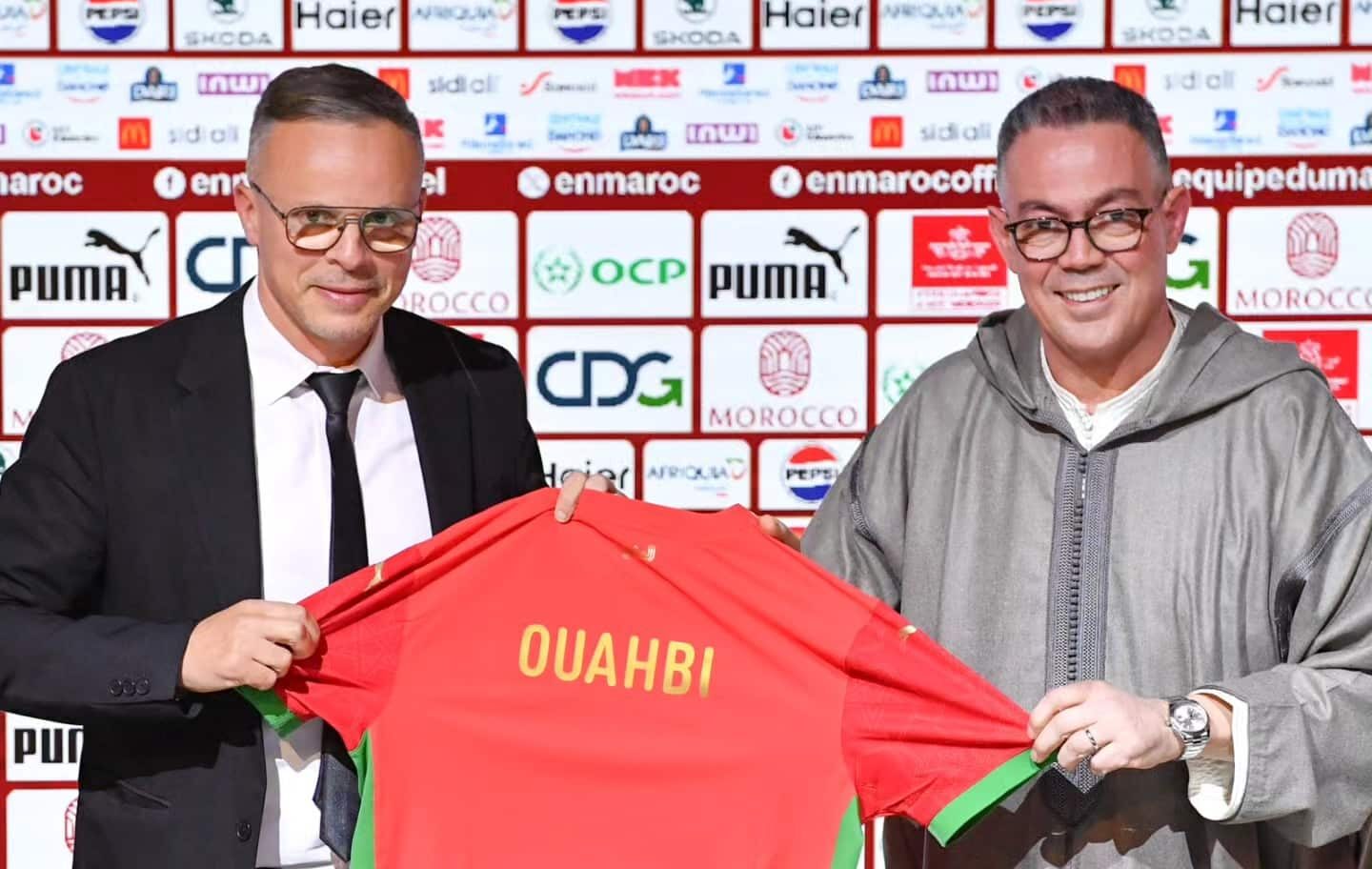
In football, the spotlight usually belongs to players and their performance on the green field. But behind every great team, there’s a mind building, planning, and preparing for what comes next. In Morocco’s case, that man might just be Mohamed Wahbi.
Born in Brussels in 1976 to an Amazigh family from Morocco, originally from the small town of Bni Chiker in the northern Rif region near Nador — the same hometown of the legendary writer Mohamed Choukri. Wahbi’s path into football wasn’t the typical one. He did not have a big playing career. Instead, Wahbi started his career as a school teacher. One of the best advantages that defines him is his ability to understand people, especially young players.
That ability was developed over nearly two decades at Anderlecht, one of Belgium’s top clubs. There, Wahbi wasn’t just a coach, he was helping shape futures of many youths. Players like Romelu Lukaku and Jérémy Doku came through that system, where Wahbi was involved in an environment focused on patience, discipline, and long-term development.
Upon receiving Morocco’s call from Fouzi Lekjaa, president of the Royal Moroccan Football Federation, Wahbi accepted without hesitation. And it didn’t take long for his impact to be felt. Leading the national youth teams, Wahbi guided Morocco’s U-20 team to a historic World Cup title in Chile in 2025. Led by a group of previously unknown young players such as Maama and Zabiri, Morocco went on an unforgettable run, defeating football giants including Argentina, Brazil, Spain, and France. It was a moment that went beyond winning the golden trophy — it confirmed that something bigger was being built behind the scenes.
Now, as Morocco begins to look beyond Walid Regragui’s historic run at the 2022 FIFA World Cup—where he led the Atlas Lions to an unprecedented semi-final—Mohamed Wahbi’s name is quietly entering the discussion. Not because he seeks the spotlight, but because his work is steadily making its own case.
A coach who trusts the next generation
What stood out in Morocco’s recent friendlies wasn’t just the results, it was the choices. Wahbi showed early on that he isn’t afraid to look forward. He brought in new faces, young players who represent the future, without turning his back on experienced leaders like Yassine Bounou or Achraf Hakimi.
It’s a delicate balance, and one that few coaches manage well. But Wahbi seems to understand it: you don’t rebuild by breaking everything — you build by adding, step by step.
As he himself stated:
“I carry a moral responsibility to lead the national team… but I won’t make a radical overhaul. I’m not here to dismantle what has been built.” — Mohamed Wahbi
And as he also explained to the official website of the Royal Moroccan Football Federation:
“We will enter this competition with great ambition, confidence in ourselves and in what we are capable of achieving, as well as in Moroccan football and what it has come to represent over many years.
We are aware that we are required to perform at the level of this event, and we will do everything in our power to achieve that. We are happy and satisfied with how things are progressing, and we are excited for the start of the U-20 World Cup. Only a few days remain, and we know the wait is difficult, but the excitement is high among both the players and the technical staff. We must stay calm and prepare in the best possible way so that, God willing, we are ready for match day.”
Names like Ismail Baouf, Redouane Halhal, Zakaria El Ouahdi, Samir El Mourabit, Ryan Bounida, and Yassine Jassem are starting to emerge. Not as experiments, but as real options. And behind them, there’s an even deeper pool of talent waiting for their first chance.
Much of this comes from years of structured work in Moroccan football, scouting networks across Europe, strong youth development, and well structured institutions like the Mohammed VI Football Academy. The result? A generation that is not only talented, but ready to shine without any inferiority complex.
2026 is just the beginning
For Wahbi, the 2026 World Cup isn’t just a tournament to compete in, it’s part of a bigger picture. The current core of the team, players with World Cup experience and proven quality, will still be there. But what Wahbi is building goes beyond that. He’s preparing a transition, one that could define Morocco’s future, especially with the 2030 FIFA World Cup set to be hosted on home soil. Some of the young players being introduced today may not be starters yet. But by the end of the next World Cup cycle, they might be the ones leading the team to toward the next World Cup triumph, making Morocco the first African nation to win the tournament…why not!
More than tactics
People sometimes compare Wahbi to big tactical names, but that’s only part of the story. He isn’t loud, he doesn’t chase headlines, and he doesn’t try to be the spotlight of attention. What he does instead is simpler and harder. He works, he observes, and he builds.
From school classroom in Brussels to the edge of Morocco’s biggest football stage, Mohamed Wahbi’s journey is a reminder that success doesn’t always come from where people expect it. And if things continue this way, he won’t just be remembered as the coach who followed an era but as the one who quietly built the next one.