
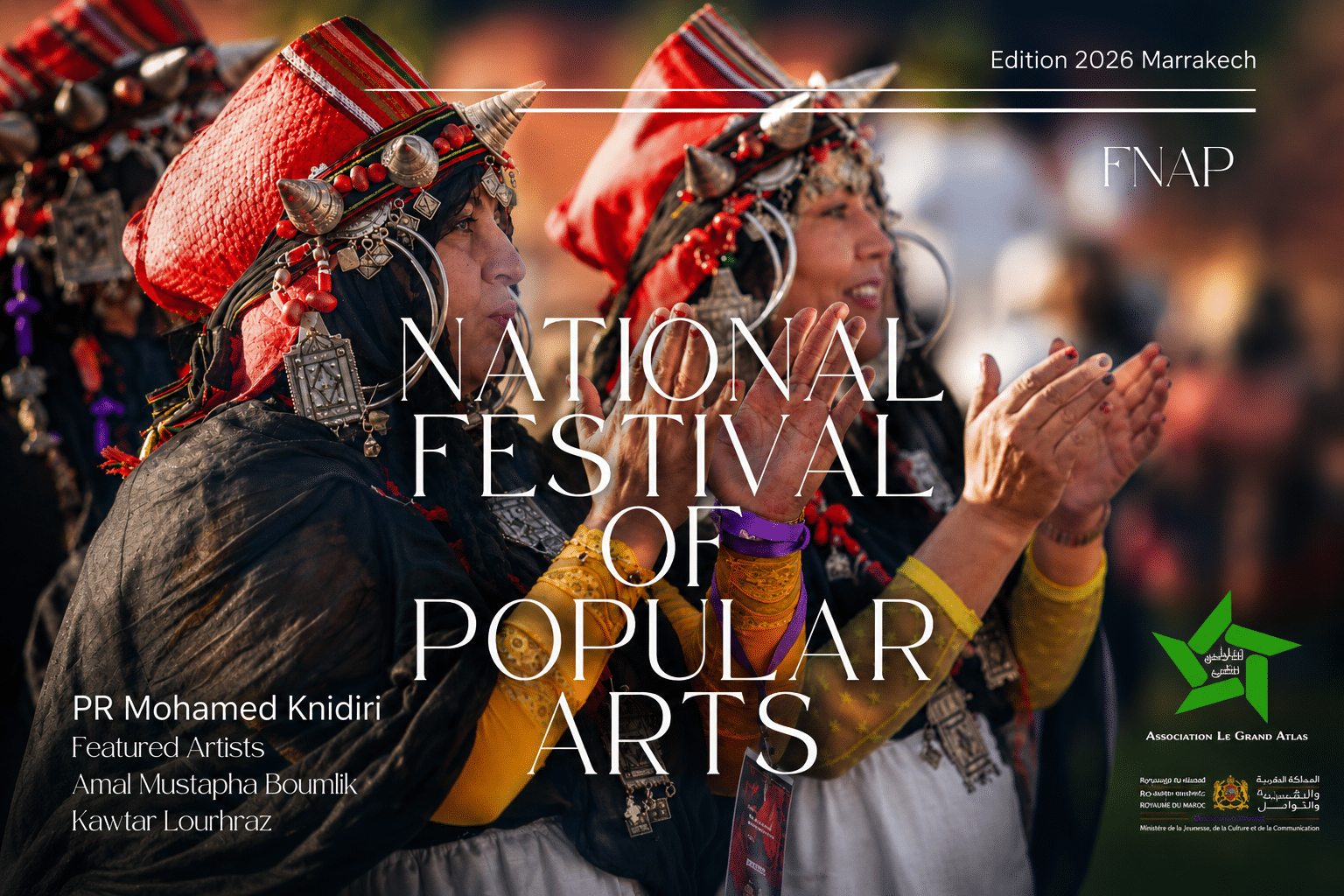
Festival National des Arts Populaires · Marrakech 2026
A dialogue between light, shadow, and heavy texture…
When a documentary photographer and a contemporary painter are given the same stage — one raises a camera, the other a knife. What emerges between them is something neither could make alone: a living archive of Amazigh memory.
In one of the most anticipated artistic partnerships of the 2026 cultural season, two Moroccan artists have joined forces as the official featured collaboration of the National Festival of Popular Arts (FNAP) in Marrakech — one of the oldest and most prestigious celebrations of Moroccan folk tradition in the world. The collaboration unfolds under the esteemed direction of Pr. Mohamed Knidiri.
At the heart of the project stand two distinct sensibilities: the documentary precision of photographer Amel Mustapha Boumlik, and the material intensity of contemporary painter Kawtar Lourhraz. Their artistic vocabularies could hardly seem more opposed — one works in fractions of a second, the other builds up layers over hours. And yet, in the context of FNAP, they have discovered an unexpected and deeply felt common ground.
Two Artists, One Visual Language
Amel Mustapha Boumlik
Documentary Photography
Amel’s lens seeks what she calls “presence” — the fleeting, unrepeatable instant in which ancestral tradition reveals itself. Working across the stages and alleyways of FNAP, she hunts for the sacred ordinary: a dancer mid-breath, a musician’s hands in motion, the charged silence before a performance begins.
Kawtar Lourhraz
Contemporary Painting
Kawtar works in impasto — thick, sculptural paint applied with a palette knife to build up not just color but mass and topography. Where Amel captures the ephemeral, Kawtar insists on permanence, pressing memory into physical layers that carry the weight of what they represent.
Together, they are mapping what they call a “shared visual language” rooted in Amazigh heritage — the ancient Indigenous culture of North Africa whose traditions, symbols, textiles, and music form the backbone of FNAP’s programming. Amel captures the event’s living pulse; Kawtar transmutes those photographic moments into expansive, textured paintings where the pigment itself becomes a kind of memory.
“From the vibrant energy of the stage to the intimate, unseen artistry behind the scenes — a dialogue between light, shadow, and heavy texture.”
A Celebration of Morocco’s Living Heritage
FNAP has been a fixture of Marrakech’s summer calendar for decades, drawing performers, craftspeople, musicians, and poets from across Morocco and the wider Amazigh world. It is simultaneously a competitive festival, a living ethnographic record, and an act of cultural maintenance — a gathering that insists, year after year, that the roots hold.
The 2026 edition marks a notable expansion of the festival’s commitment to contemporary artistic response. Rather than treating folk tradition as a museum exhibit, the Boumlik–Lourhraz collaboration positions it as raw material for something new: neither nostalgia nor appropriation, but a genuine creative conversation between past and present. Their project moves fluidly between the front-of-house spectacle — the color, the costuming, the choreography — and the backstage world rarely seen by audiences: the quiet preparations, the passed-down rituals, the unguarded moments before the performance begins.
The result is being described by those close to the project as “living archives” — documents that breathe, that hold contradiction, that refuse to flatten the complexity of what it means to carry an inheritance forward.
Movement, Memory, Transformation
What makes this collaboration formally interesting — beyond its cultural significance — is the productive tension between its two mediums. Photography, even in its most documentary mode, is always an act of selection: the photographer decides what to include, what to exclude, and the shutter does the rest. Painting, especially the impasto approach Lourhraz practices, is additive by nature. You cannot subtract what you have laid down; you can only build over it, or scrape back to find what was there before.
In this sense, the collaboration is a meditation on how we relate to the past. The photograph arrests a moment; the painting reopens it. Together, the works ask: what does it mean to remember something that is still happening? How does a tradition remain alive without becoming a performance of itself?
As the 2026 festival unfolds across the ancient streets and vibrant public squares of Marrakech, the full scope of this project will gradually reveal itself. What is already evident is that Boumlik and Lourhraz have produced far more than a visual record of FNAP. They have created a compelling artistic statement celebrating Amazigh culture, one of the oldest continuously living cultures in the world, captured through two of the most powerful and tangible forms of artistic expression. ⵣ
Official Feature — Festival National des Arts Populaires, Marrakech 2026
Under the direction of Pr. Mohamed Knidiri
Photography: Amel Mustapha Boumlik · Painting: Kawtar Lourhraz