
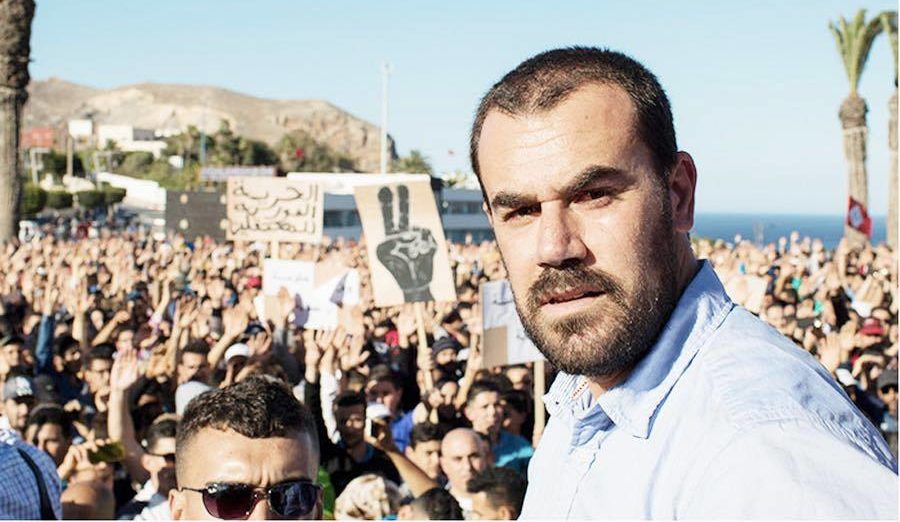
His Rifian kin call him Bounassa. Some name him the Moroccan Gandhi; others compare his courage to that of Abd el-Krim Al-Khattabi. To a few, he is a living pasionaria. But to me, Nasser Zefzafi has always been a modern-day Icarus—not a figure of myth, but a metaphor for our Moroccan reality: we dream of liberty, only to feel our feathers loosen and fall as we try to take flight.
Before Zefzafi’s rise in October 2016, there was a fisherman named Mohsen Fikri. Going through the difficult routine of a daily breadwinner in the seaport of Al-Hoceima, Moroccan authorities decided to confiscate his swordfish under the pretext of being caught off season. Refusing to give bribes to reclaim it, his fish was thrown into a garbage truck. Unable to bear the insult, he rushed to retrieve what remained. As the garbage compactor was activated to scare him, he was tragically crushed alongside his fish. Witnesses claimed that an authority figure said, in Moroccan slang, “crush him too.” This chilling statement reopened the wounds of “Hogra” being practiced by the regime against the citizens, particularly the people of the Rif.
Just around the corner from the seaport stood Nasser Zefzafi, who soon joined a small group protesting this dehumanizing murder. Up to that night, no Moroccan had heard his name—he was known only locally for the YouTube streams he once shared. Like many youths in the Rif, Nasser dropped out before finishing high school. He drifted from waiting tables to guarding doors, before unemployment claimed him too, after a modest electronics shop he ran with a friend drowned in debts and shut down.
Nasser joined peaceful marches, lighting candles and laying flowers to honor the death of Mohsen Fikri. For them, Fikri is a symbol for the ordinary Rifian youth who are victims of economic hardships, marginalization, and authoritarianism. Honoring his martyrdom, these small marches quickly grew into one of the largest and most organized peaceful demonstrations the reign of King Mohamed VI had seen. It was simply called the Hirak Rif.
Activists like Nabil Ahmjik, Samir Ighid, Mohamed Jelloul, Mohamed Haki, Zakaria Adehchour, and many others convinced all provinces of the Rif to mobilize in peaceful demonstrations. Unlike the February 20 Movement, they did not demand political reforms; they sought to end the chain of marginalization and injustice towards the Rif by establishing a well-equipped hospital with an oncology center for cancer treatments, a university unit, and withdrawing the militarization order off Al-Hoceima, by which it stayed stigmatized, secluded, and undesirable by investors.
As the aforementioned activists mostly remained in the shadows, Nasser emerged as the de facto leader of the Hirak with his fiery speeches and charismatic persona. Through his captivating speeches, he viewed Mohsen Fikri as an extension of long-standing state violence against the Rif.
“I swear to God, you know nothing about collective memory.”
Inhabiting the high mountains of the North, the J’bala and Rifian tribes have long lived by a code of honor, hospitality, and justice, organized through clans and kinship networks. Under Abd el-Krim’s unifying leadership, they pioneered guerrilla resistance against Spanish colonialism, defeating Spain at the Battle of Anoual in 1921, delivering the first defeat to a major European imperial power, and declaring the Rif region an independent republic. Spain soon retaliated with chemical warfare, destroying villages, crops, and water sources—a legacy tied to the region’s high cancer rates today. In 1926, Abd el-Krim surrendered to protect the Rif from suffering after bombardment by French, Spanish, and—bitterly—Makhzen forces under Alawi Sultan Moulay Youssef, a betrayal still etched in Rifian memory as the Moroccan Sultan sided with the colonizers.
Shortly after independence, the central authority sought to bring the region under its full control. In 1958, Crown Prince Hassan II’s parade in Al-Hoceima was disrupted by some clan leaders in protest over his grandfather’s complicity in the dismantling and exile of Abd el-Krim. The Royal Army was then ordered to use cruel means to suppress the 1958–59 revolt, subsequently declaring the city a besieged military zone fearing future uprisings. Upon their withdrawal, the army destroyed food stocks, leaving people to starve.
Merely healed from the wounds of ’59, the Bread Riots of 1984 erupted in the North following the government’s decision to raise the prices of bread and other staples. Under the orders of King Hassan II, the riots were brutally suppressed and followed by the famous Awbāsh speech—meaning bastards—as he referred to the people of the Rif and North as “Awbāsh… the unemployed living by smuggling and theft.” This left the region stigmatized with these descriptions even after the conclusion of Hassan II’s Years of Lead.
Mohsen Fikri was not the only figure killed by authorities in the region. As recently as 2011, the February 20 Movement in Al-Hoceima was shocked, in its first two days, by news of five charred bodies found in a bank branch after a protest turned violent. Activists from the movement accused the Makhzen authorities of responsibility for the deaths and questioned the official narrative, which blamed the incident on rioters and looters.
Nasser carried the pain of all this collective memory on his back, something he often made very clear in his speeches, such was the case when he addressed Aziz Akhanouch, then Minister of Agriculture and Maritime Fisheries and now Head of Government, whose party accused the Hirak of misrepresenting the region’s collective memory. Nasser replied in a famous speech, “I swear to God, you know nothing about collective memory.”
Hirak Rif: Another Painful Memory for the Rif.
In a historically marginalized region plagued by unemployment and high rates of migration, the Hirak emerged as a collective implosion seeking to break away from this reality and to shatter the chains of necropolitics that have dominated the region since the colonial era.
Nasser’s rise to prominence was an anomaly that shocked the political elite. He seemed to emerge from nowhere: he had no higher education credentials, no history of involvement in NGOs, political parties, or unions. Although not a native speaker of Arabic, he mesmerized audiences with his eloquence, knowledge, and charisma, which made his live, unscripted speeches go viral on social media, exerting an influence unmatched by any elected politician.
Along with other Hirak activists, he succeeded in globalizing the social protest while fostering a unified regional identity and commitment to the Rif, symbolized by the presence of the Amazigh flag. The Makhzen forces attempted to use both carrots and sticks to quell the protest. However, the Hirak leadership refused to negotiate with any Interior Ministry official as long as Wali Mohamed El Yaacoubi remained in office, since his dismissal was at the top of their demands list.
Not only did they view such officials as complicit in the death of Mohsen Fikri and the de-development of the region, but they also refused to negotiate with political and corrupt elected parties. For them, these self-serving parties were merely pawns of the Makhzen, with no legitimacy to represent or respond to their list of demands. Thus, in an unprecedented move, the Hirak leaders addressed their demands directly to the King—as the highest authority—asking him to intervene personally, as they had no trust in the “political storefronts,” as Nasser constantly referred to them.
The Hirak gained international coverage, but the demands were left unanswered. The Makhzen launched counter-tactics to suppress it. First, by trying to provoke violent reactions from the protestors through verbal violence and threats of rape or arrests. When this failed, it launched an ideological war to delegitimize the movement’s demands. The coalition government issued a statement accusing the Hirak movement of “separatism” and serving “foreign agendas.” Massive smear campaigns were launched to delegitimize the movement and strip it of popular support. Defamatory state-sponsored media outlets attacked the activists, portraying them as immoral traitors receiving money from abroad to revive Abd el-Krim’s republic. Le360, an outlet close to the Royal Palace, even compared Nasser Zefzafi to ISIS leader Al-Baghdadi. Meanwhile, state-owned media invested in the politics of fear, warning citizens of a Syrian-like outcome should the Hirak succeed.
Still, this did not hinder Nasser from becoming a national hero, as he exposed the state’s corruption and the centralization of wealth and development projects in only certain regions, leaving those it deemed “unbeneficial” underdeveloped. It was then that the state resorted to religious warfare against the Hirak, with the Ministry of Religious Affairs instructing imams in the Rif to deliver sermons warning against fitnah—a religious term often used to condemn actions seen as threatening the Umah’s unity.
On May 26, 2017, seven months after the Hirak began, Nasser Zefzafi interrupted a Friday khutbah, accusing the imam of acting as a mouthpiece for the Makhzen, stressing that mosques are “built to worship God, not those in power.” Two days later, he was cruelly beaten, tortured, and arrested after prosecutors issued warrants for his arrest, alleging that he had “obstructed, in the company of a group of individuals, the freedom of worship.”
After the mosque incident, the Makhzen adopted an oppressive, militarized approach to weaken the Hirak. This strategy backfired, as calls for the activists’ release were soon added to the movement’s list of demands. Tensions escalated further when the Interior Ministry deployed the army to besiege the area, restricting journalists from covering it.
During Ramadan, a state curfew was announced to prohibit assembly and protest, resulting in massive waves of arrests that extended to minors. Tensions between the region and the Makhzen forces reached a climax on July 20, 2017, when excessive violence was used against protestors, resulting in Imad El Attabi being struck in the head by a tear gas canister, which later caused his death. From that point onward, the Hirak entered a dark phase.
Imad’s death sparked outrage not only in the region but across the country. Yet arrests only intensified, with Amnesty International reporting that more than 400 activists were detained—marking the largest crackdown on a protest and a blatant violation of the rights to peaceful protest, assembly, and expression. On the occasion of Throne Day, July 29, the King delivered a speech praising the police forces for their “composure and adherence to law,” while placing the blame for the events entirely on political parties. Human Rights Watch reported otherwise, noting that leaked doctors’ analyses showed activists had been subjected to torture and violence—especially after a leaked audio recording in which Nasser claimed he had been tortured and raped during his arrest.
The following year’s Throne Day speech, delivered from Al-Hoceima, was criticized by many activists, who argued that it was a declaration of victory rather than a response to key Hirak demands, including the release of detainees.
The Fall of Icarus
After numerous arbitrary arrests and lack of a fair trial, the Hirak activists received harsh prison sentences, with activists like Nasser receiving 20 years. Nasser was sentenced for the felonies of “conspiring against” and “undermining the internal security of the state” as well as “holding public gatherings without prior authorization.” Amnesty highlighted that these charges go against Morocco’s international obligations, especially since confessions were extracted through dehumanization and torture, which goes against the right to a fair trial.
The reign of Mohamed VI was established on the promises of the Equity and Reconciliation Commission, which stressed cutting ties with the old regime, declaring that Morocco would never again resort to oppression and violence to crush dissent or opposition. However, with these harsh sentences against the activists and the subsequent crackdowns on independent journalists, many claimed this was a fast ticket back to Hassan II’s Years of Lead, proving that even the constitutional reforms of 2011 were just a myth.
Nasser’s tragic flaw is that he rose high enough and addressed the monarchy. For a figure who has never—never given an interview to a Moroccan outlet—he was not going to descend for Zefzafi either. Instead, Zefzafi’s wings had to be burnt to fall, so others do not follow his path. Like gravity for Icarus, what made the fall harsher was the lack of an independent judicial system, which Nasser accused of operating through “remote control.” Contributing to his dilemma, Nasser fought not only against the Baltagiya, political parties, and media campaigns that smeared him, but also against religious institutions, which proved to be extensions of the Makhzen’s hegemony and methods of control.
Nasser’s dilemma was that his opponent did not play fair, especially since the movement was overshadowed by the polemic and nightmarish history of the Rif Republic for the Moroccan regime. Then, like wax failing Icarus’s wings, Nasser was also betrayed by Moroccans who chose fear over the opportunity to dream of a bitter yet different reality—one not controlled by a hegemonic or oppressive state.
Almost nine years since Fikri’s death, the Rif is still dependent on remittances and marked by unemployment, and most of all, migration of its youth, which also befell the Hirak activists who were released or pardoned, as they could not integrate after a heavy sense of despair settled over the population following the Hirak. For those who could survive unemployment, they could not survive life. Such was the case of the activist Salah Eddine Shaabout, who took his own life in September 2021.
Although it is beyond late, if the state truly desires total reconciliation with the Rif, it must first immediately release all Hirak prisoners, acknowledge the violations it committed in the region, and embrace the collective memory of the area as a dark chapter in Morocco’s history—rather than responding with total denial. A new leaf will never be turned through force.
Meanwhile, the key Hirak activists have remained exempt from royal pardons, which are only granted when political prisoners agree to sign confessions admitting to the crimes they are accused of. The Hirak activists refused to do so. However, in August of last year, the UN Working Group on Arbitrary Detention issued an Opinion declaring Zefzafi’s detention arbitrary and called for his immediate release. Recently, Human Rights Watch and partner organizations appealed to the king to grant the humanitarian release of Nasser Zefzafi and the remaining activists, following the diagnosis of his father, Ahmed, with stage IV cancer and the deteriorating health of his mother, Zoulikha.
On September 3, 2025, activist Ahmed Zefzafi passed away with his final wish unrealized: to see his son and the other Hirak Rif activists free. Now, eight years into his sentence, his son Nasser has earned a high school diploma and is pursuing a BA in law from behind bars, framing his education as an act of resistance. On August 11, 2025, he announced a hunger strike in solidarity with the people of Gaza and Sudan, and later endorsed the GenZ212 protests, which also urgently demanded saving the crumbling health and education sectors, as well as accountability for the corrupt government of Aziz Akhannouch.
The number one problem and ”brake” to Morocan and especially Amazigh people is the royal familly. Since they have zero legitimacy (remember they betrayed the Rif revolt an were retributed by French criminal Lyautey with the Morocan kingdom).