
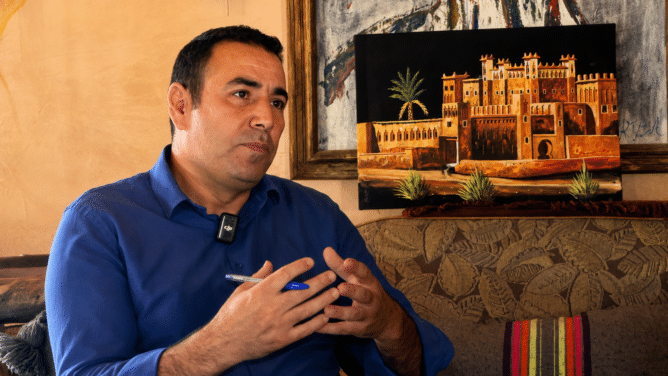
Moroccan artist and researcher Omar Ait Said has warned that Amazigh children remain underserved by cultural and educational production, arguing that language policy cannot succeed if young learners do not find stories, songs, games and media in their own cultural environment.
In remarks reported by Al3omk, Ait Said said the shortage of Amazigh-language children’s literature and artistic content remains a major gap despite the efforts of the Royal Institute of Amazigh Culture and several local associations. He pointed to initiatives in Souss, Kalaat M’Gouna and Boumalne Dades, but said many projects still depend on individual teachers, artists and activists rather than a sustained institutional strategy.
The issue is not only about publishing more books. Ait Said linked children’s culture to the wider question of identity formation, saying schools risk producing pupils disconnected from Amazigh cultural references when heritage is absent from textbooks, preschool settings, television and artistic activities. He also criticized the limited presence of dedicated Amazigh programming for children on public media.
One of his proposals is to give music and song a more serious role in Tamazight education. Ait Said said he is researching Amazigh song as a pedagogical tool, not as a casual classroom addition but as material that can be structured into lesson plans, values education and language learning. Songs, he argued, can teach vocabulary, memory, solidarity and cultural imagination in ways that reduce the pressure often associated with formal schooling.
He also addressed artificial intelligence, treating it as a practical tool that can help produce songs, images and videos for Amazigh education if guided responsibly by speakers and educators. For him, the central question is not whether technology should be used, but who directs it and what cultural purpose it serves.
Ait Said’s critique comes as Morocco moves through another electoral cycle in which parties speak frequently about infrastructure and regional development. He argued that roads and buildings are not enough if public policy neglects what he called human development: children, artists, local media, cultural camps and the creative spaces needed to keep Amazigh heritage alive.