
November 11, 2026 | News Report
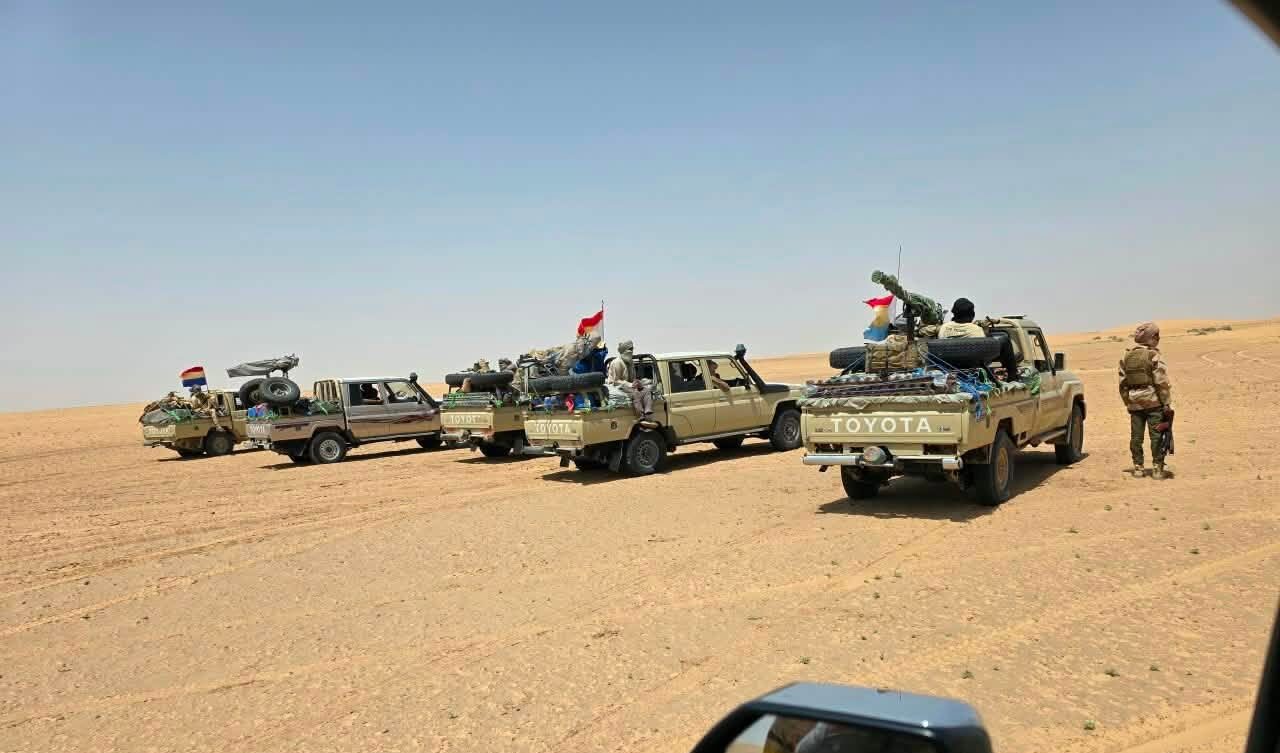
Northern Mali’s Azawad region is experiencing another period of military escalation as Malian government forces, supported by Russia’s Africa Corps, continue operations against the Azawad Liberation Front (FLA). The fighting has raised serious humanitarian concerns, with reports of civilian casualties, including women and children, following airstrikes and drone attacks.
The latest developments have also heightened security concerns along Mali’s border with Algeria, where military operations, population displacement, and the increasing use of armed drones threaten to destabilize an already fragile region.
Kidal Returns to Malian Control, but the Conflict Continues
The reported recapture of Kidal on October 6, 2026, marked a significant development in the conflict between the Malian military and Azawad independence fighters.
Kidal has long been regarded as a political and symbolic stronghold of the Azawad movement. Its loss represented a major setback for the FLA, although the movement described its withdrawal as a deliberate strategic decision rather than a military defeat.
In a statement dated October 6, the FLA said its forces had carried out an organized withdrawal to protect civilians from intensive aerial bombardment, prevent further destruction of infrastructure, and preserve their military capabilities.
The movement reaffirmed its determination to continue fighting for the political aspirations of the Azawad people.
For Mali’s military authorities, regaining Kidal represents an important step toward restoring government control over northern territories.
However, controlling the city does not necessarily mean controlling the wider Azawad region. Vast desert territories, including Tinzaouaten, Aguelhok, Tessalit, and Anéfis, remain strategically important because of their geography and their proximity to international borders.
Drone Warfare Becomes a Central Feature of the Conflict
The increasing use of military drones has significantly changed the nature of the fighting in northern Mali.
Malian forces and their Russian allies have increasingly relied on aerial surveillance, armed drones, and airstrikes to target suspected positions and supply routes associated with Azawad fighters.
According to a November 10 report by Africa Defense Forum, evidence gathered from drone wreckage and battlefield imagery points to the use of Russian-manufactured equipment by Africa Corps personnel.
The report cited data from the Armed Conflict Location & Event Data Project (ACLED), indicating that 89 civilians were killed in 49 airstrikes attributed to Malian forces and Africa Corps between April and August 2026.
These reported casualties have intensified concerns about the protection of civilians and compliance with international humanitarian law.
Meanwhile, the Azawad Liberation Front has also reportedly expanded its use of attack drones.
On November 5, the movement claimed responsibility for suicide-drone strikes against a military camp housing Malian forces and Russian personnel in Anéfis, in the Kidal region.
The extent of the damage and the number of casualties from that attack have not been independently established.
The growing reliance on drones suggests that the conflict is evolving from conventional battles for control of cities into a prolonged war of attrition involving remote strikes, mobile fighters, and attacks on isolated military positions.
Civilians Pay the Highest Price
Beyond the military developments, the humanitarian consequences of the conflict remain deeply troubling.
A report published on November 1 by the human rights organization Kal Akal documented a series of alleged attacks against civilian settlements, vehicles, and commercial locations during October.
Among the incidents described was an airstrike on a nomadic encampment near Léré, reportedly killing 13 civilians, including six children.
The organization also reported that 15 gold miners, most of them Chadian nationals, were killed in attacks around Talhandak, near the Algerian border, on October 20.
These accounts illustrate the vulnerability of communities living in remote desert areas, where access to medical assistance, emergency services, and humanitarian protection is extremely limited.
However, some casualty figures and details remain difficult to verify independently because of restricted access to conflict zones.
Human Rights Watch has also raised concerns about alleged abuses committed by Malian government forces and their Russian allies.
In an October 22 report, the organization documented allegations involving civilian killings, arbitrary detention, and torture.
Among the incidents examined was a September 16 drone strike in Guelédi, in central Mali’s Mopti region, which reportedly killed at least eight civilians and injured six others.
Human Rights Watch called for independent investigations and accountability for violations of international humanitarian law.
Allegations of Tuareg Children Being Used in Military Operations
Another disturbing development involves allegations circulating on social media that Tuareg children have been placed near the front lines of military operations.
Activists have shared images and videos they claim show children being exposed to military danger, with some accusing Malian forces of using them as human shields.
These allegations are extremely serious, but the authenticity of the circulating material, the identities of those involved, and the circumstances in which it was recorded have not been independently established.
International humanitarian law prohibits the use of civilians as human shields, while international legal protections restrict the recruitment and use of children in armed conflict.
Any credible evidence that children have been deliberately exposed to military attacks or forced to participate in hostilities warrants an impartial investigation.
The protection of children must remain a priority regardless of the political or military objectives of the parties involved.
Algeria Faces Growing Security Concerns Along Its Southern Border
The military escalation in Azawad is increasingly becoming a regional security concern, particularly for Algeria.
Areas such as Tinzaouaten and Talhandak lie close to the Algerian frontier, where military operations involving drones and aircraft create additional risks for border communities.
The use of explosive drones and aerial bombardment near international borders raises concerns about accidental incursions, falling debris, and the possibility of strikes affecting neighboring territory.
There are also humanitarian implications.
Continued fighting could force more civilians to flee toward Algeria or other neighboring countries, placing additional pressure on already vulnerable border communities.
For Algeria, the situation presents challenges involving border surveillance, airspace security, refugee movements, and the prevention of armed groups operating across national boundaries.
These concerns are especially significant given Algeria’s historical involvement in mediation efforts aimed at resolving the conflict in northern Mali.
Azawad’s Long Struggle for Political Recognition
The conflict in Azawad cannot be understood solely through recent military developments.
Its roots extend back decades, reflecting longstanding disagreements between successive Malian governments and movements representing communities in the north, particularly Tuareg populations.
Azawad movements have repeatedly raised grievances concerning political representation, economic marginalization, cultural recognition, and the distribution of state resources.
Some movements have advocated independence, while others have pursued autonomy or negotiated political arrangements.
Malian authorities, by contrast, maintain that the country’s territorial integrity must be preserved and that military operations are necessary to restore state authority and combat armed organizations.
The situation has become more complicated because several different conflicts overlap in northern Mali.
Azawad political and armed movements operate in the same broad region as jihadist organizations affiliated with al-Qaeda and the Islamic State, although their political objectives and organizational structures differ.
The growing involvement of Russian military personnel has added another dimension to the conflict, particularly amid allegations of abuses against civilians.
A Military Victory Does Not Guarantee Peace
The recapture of Kidal may have changed the military balance, but it has not resolved the political grievances underlying the conflict.
Azawad fighters continue to claim that their struggle is far from over, while the Malian government remains committed to restoring control over northern territories.
The increasing use of drones, combined with the involvement of foreign military forces, risks prolonging the fighting and exposing more civilians to violence.
For communities across Azawad, the consequences are already visible: families displaced from their homes, children growing up amid insecurity, livelihoods destroyed, and communities struggling to survive in an increasingly militarized environment.
The conflict also raises a fundamental question about the future of northern Mali.
Can lasting stability be achieved through military operations alone, or will a political settlement addressing the grievances of Azawad’s communities ultimately be necessary?
As fighting continues, the immediate priority under international humanitarian law remains the protection of civilians, the investigation of alleged abuses, and the prevention of further humanitarian suffering.
For the Azawad, the struggle is no longer only about who controls the territory. It is also about whether communities can live in safety, preserve their cultural identity, and determine their future without the constant threat of war.