
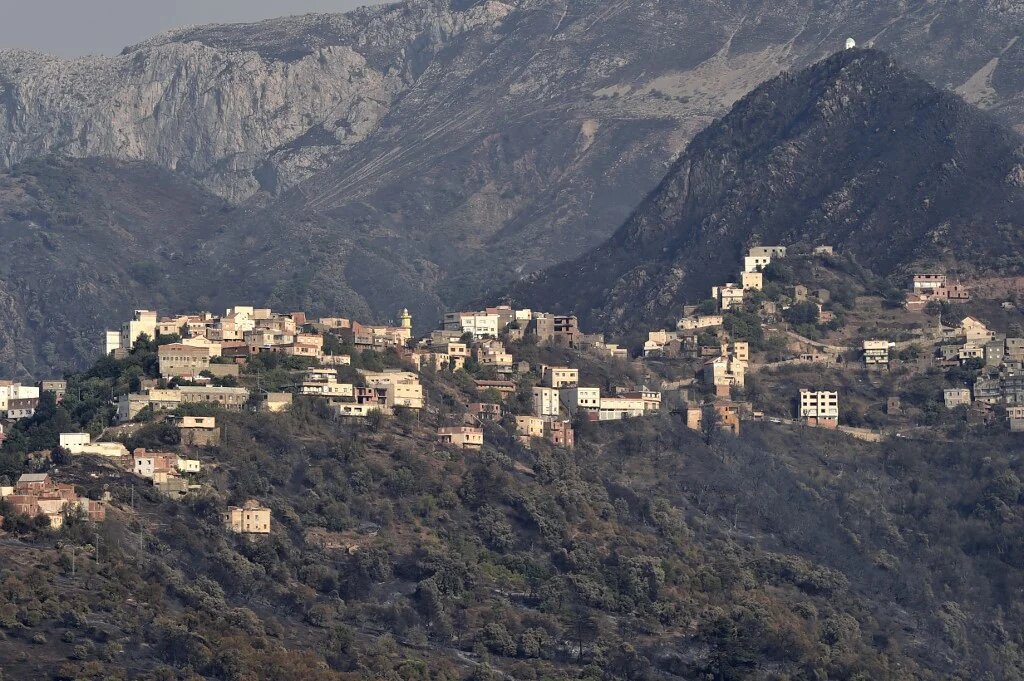
In Algeria’s Oued Sahel-Soummam Valley, climate change is no longer only an environmental story. It is becoming a story about land, migration, work and the meaning of Kabyle identity.
A recent analysis by Ilyssa Yahmi for the Carnegie Endowment for International Peace examines how farmers in rural Kabylie are confronting a cycle of drought, wildfire risk, water scarcity and economic pressure. The study focuses on a fertile valley stretching from Bouira toward Bejaia, where small landowners have long cultivated olives, figs, cherries, pears and other tree crops on fragmented plots.
The central warning is stark: adaptation itself can deepen vulnerability when it is driven by short-term economic and administrative incentives rather than ecological reality. Algeria’s agricultural policy has emphasized mechanization, higher yields and expanded production. But in Kabylie, Carnegie argues, that approach does not fully address the fragility of smallholder farming or the social cost of a changing rural economy.
Two agricultural worlds now coexist in the region. One is the declining world of self-sufficient peasant farmers, many of them in mountain areas, whose families have worked the same land for generations. They face unreliable water access, aging rural populations, fragile ecosystems and climate shocks. The other is a growing class of business-oriented agricultural entrepreneurs with more capital, better irrigation infrastructure and stronger market connections.
Climate pressure affects both groups, but not equally. Water scarcity and soil erosion are making rain-fed olive cultivation harder to sustain. Wildfires have become a recurring seasonal threat. Traditional practices such as plowing with oxen are increasingly rare, preserved by some farmers not because they are profitable, but because they represent heritage.
At the same time, modern adaptation can carry hidden costs. Carnegie notes that drilling and intensive irrigation allow some producers to keep expanding, yet they can also accelerate depletion of the resources on which agriculture depends. Older collective water systems, including local earthen irrigation channels known in Kabylie as terga, are giving way to private infrastructure that benefits those able to pay for it.
The crisis is also reshaping mobility. Some young Kabyles leave agriculture for other careers, other parts of Algeria or Europe. Diaspora capital is flowing back into land and equipment, helping larger agricultural ventures grow while smallholders struggle to keep up. Farmer registration, because it can unlock subsidies or administrative advantages, has also taken on meanings beyond farming itself.
What is disappearing is not only a way of producing food. It is a social arrangement. Carnegie describes rural Kabylie as moving away from multigenerational ancestral homes and toward more suburban economic models. Farming becomes one income source among many, or a symbolic link to family land rather than the center of household life.
For Amazigh communities, this raises a question that goes beyond climate policy. Kabyle identity has long been tied to language, land, village structures and memory. If climate stress, migration and market forces continue to hollow out mountain agriculture, the region may preserve the symbols of rural heritage while losing the daily practices that carried them.
The policy challenge is therefore not simply to produce more. It is to protect water, support smallholders, create meaningful rural employment and treat ecological resilience as part of cultural survival. In Kabylie, the future of the land is also the future of home.
## Sources
– Carnegie Endowment for International Peace: “Climate Pressures in Algeria: The Crisis in Rural Kabylie,” Ilyssa Yahmi, May 9, 2026: https://carnegieendowment.org/research/2026/05/climate-pressures-in-algeria-the-crisis-in-rural-kabylie