
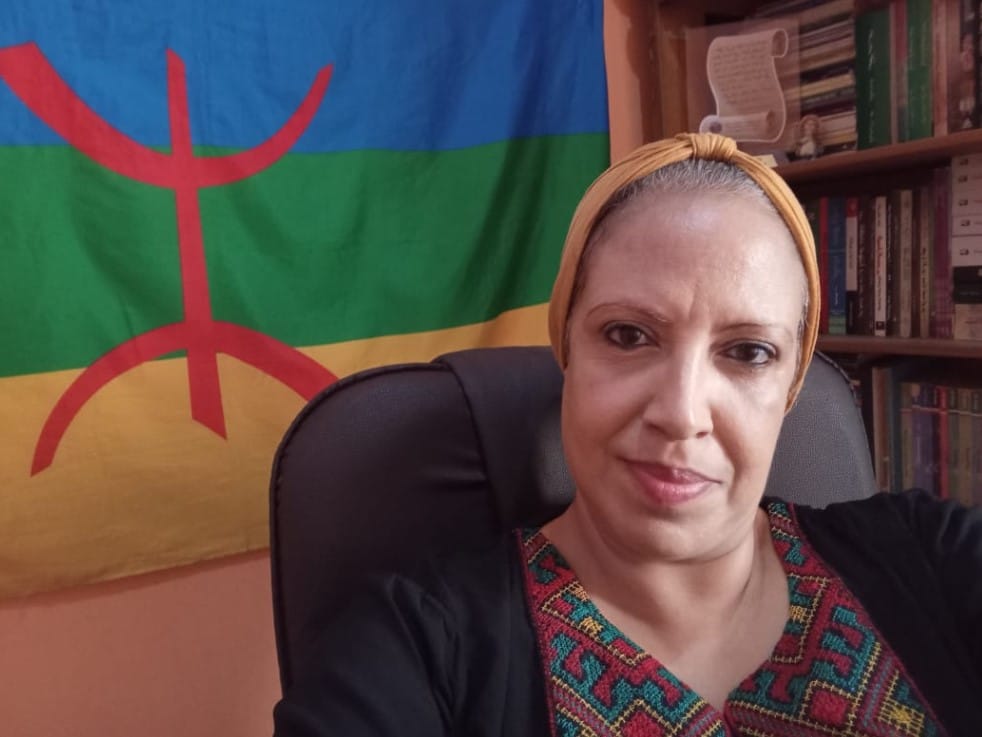
Cairo/Siwa — For months, one of Egypt’s most recognizable Amazigh rights advocates, Amani El-Weshahi, has been held behind bars, largely out of the public eye, in a case that her community says fits a pattern too familiar to indigenous advocates across North Africa: a prominent voice for Amazigh identity, silenced through the machinery of state security.
Who Is Amani El-Weshahi
Amani Abdel Wahed El-Weshahi is an Egyptian researcher, writer, and activist born in Port Said in 1973. She traces her lineage to the Farkhana tribe and has spent years advocating for the recognition, rights, and cultural preservation of Egypt’s Amazigh community, particularly in and around Siwa Oasis. She serves as the representative of Egypt’s Amazigh community and as vice president of the Amazigh World Congress in Egypt.
Her decades of advocacy work have earned her a widely used nickname in Egyptian media: “the mother of Egypt’s Amazigh people.” She is also known for broader human rights involvement, including membership in movements opposing religious discrimination and in efforts to counter sectarian violence.
A Fight Over Who Speaks for the Amazigh
Shortly before her detention, El-Weshahi was engaged in a different kind of battle — one over representation itself. She filed a legal complaint describing ongoing harassment linked to Pan-Arab movement circles, and named Omar Ragah specifically, accusing him of publicly claiming to represent Egypt’s Amazigh community despite having, in her account, no linguistic or ancestral ties to the Siwa tribes.
El-Weshahi argued that this kind of misrepresentation does real damage — that it drowns out authentic Amazigh voices and dilutes a community’s ability to define its own identity on its own terms. Several Siwa tribal elders reportedly backed her complaint, reinforcing her position that legitimate representation cannot simply be self-declared by outsiders with no genuine connection to the community. The complaint was submitted to the Egyptian Public Prosecution.
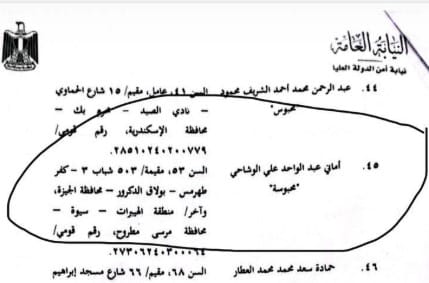
What’s confirmed and what isn’t: the complaint against Ragah is documented as a separate legal action El-Weshahi pursued. No Egyptian court record, prosecution statement, or independent news outlet has confirmed a direct causal link between that complaint and her later detention under Case No. 4880 — the two have not been officially connected. What her supporters believe, however, is a different matter, and it matters too.
The Belief Driving the “Free Amani” Campaign
Many within the Amazigh rights community reject the idea that her detention is coincidental. Their reasoning: El-Weshahi has spent over a decade as the most visible, most outspoken defender of Amazigh identity in Egypt — a role that has repeatedly put her at odds with Pan-Arabist figures and institutions uncomfortable with indigenous claims to a distinct, non-Arab heritage within Egypt’s borders. To them, a woman who had just formally challenged a rival’s legitimacy to speak for her people, and who has spent years pushing an uncomfortable question about Egyptian national identity, does not simply happen to end up in a state security case months later. They see her prosecution as retaliation dressed up in an unrelated charge — a way to remove an inconvenient voice without appearing to target her advocacy directly.
This is the community’s reading of events, not a fact established by the prosecution file. It is worth stating plainly because it is widely and sincerely held, and because Egypt’s security apparatus has a well-documented history — tracked for years by groups like the Egyptian Initiative for Personal Rights (EIPR) — of using broad, loosely defined charges against activists whose real offense, in practice, is being inconvenient to the state.
The Official Case
On paper, El-Weshahi was referred to trial under Case No. 4880 of 2025, registered with Egypt’s Supreme State Security Prosecution. Rights groups tracking the case say it stems from a wave of arrests in June 2025, when several individuals — including a 67-year-old physician with chronic health conditions — were detained pending investigation on charges of joining a terrorist organization and spreading false news. Investigators reportedly focused on the defendants’ presence in a closed social media group discussing the “Global March to Gaza,” an initiative organized by international activists and health workers aiming to help break the blockade on Gaza.
As of late August 2025, defendants in the case — including a woman in her late sixties with chronic illnesses said to require urgent release — continued to have their pretrial detention renewed. For a community convinced her real “offense” was defending Amazigh legitimacy, the official charge sheet reads, at best, as a pretext of convenience.
A Charge That Doesn’t Hold Up to Scrutiny
If “supporting Gaza” were genuinely the line Egyptian authorities would not cross, the events of this summer’s World Cup make that hard to believe. National team coach Hossam Hassan carried a Palestinian flag across the pitch after Egypt’s Round of 32 win over Australia, declared that his “heart and soul are with the Palestinians,” and dedicated the historic victory to both the Egyptian and Palestinian people. He repeated the message days later in an emotional press conference. FIFA reviewed the flag display and declined to sanction him, ruling it did not violate competition rules. Far from facing consequences at home, Hassan was greeted on Egypt’s return as a hero — crowds lined the road to El Alamein airport waving Palestinian flags alongside Egyptian ones, with banners bearing his image draped in both.
Set that against El-Weshahi and the other defendants in Case 4880: ordinary people, without a national platform, facing terrorism-related charges over private discussion of joining a Gaza solidarity march. The gap between how the state treated a celebrated coach’s public, televised Palestinian solidarity and how it has treated private citizens’ private discussion of the same cause is difficult to explain if “Gaza solidarity” were really the operative concern. It suggests the charge functions less as a description of what El-Weshahi actually did and more as a convenient legal vehicle — one that can be applied selectively, against people the state already has reason to want out of public life, while the identical sentiment is celebrated when expressed by someone useful to the state’s image. For a community that watched El-Weshahi challenge a rival’s claim to represent Amazigh identity shortly before her arrest, that gap reads less like coincidence and more like confirmation.
Calls for Her Release
Roughly two weeks ago, the Andalus Center for Tolerance and Anti-Violence Studies issued a legal and human rights statement demanding El-Weshahi’s immediate release, arguing that her continued pretrial detention conflicts with constitutional guarantees and international standards under which liberty is the default and detention the exception.
Egypt’s pattern of extended, repeatedly renewed pretrial detention — sometimes stretching for years — has long been criticized by EIPR and international rights organizations as a tool used against activists, journalists, and dissidents largely independent of the specific charges filed against them.
Why It Matters
El-Weshahi’s case has become a rallying point far beyond Egypt’s small Amazigh community, with “الحرية لأماني” — “Freedom for Amani” — circulating among indigenous rights advocates and human rights networks across North Africa and the diaspora. For many, her imprisonment is not just about one woman’s legal case. It’s a test of whether an indigenous people’s right to define its own representatives, and defend its own identity, can survive contact with a state that has never fully made peace with the fact that “Egyptian” and “Arab” are not the same thing.
As of this writing, El-Weshahi remains in pretrial detention, with her legal status tied to the ongoing proceedings in Case No. 4880 of 2025.