
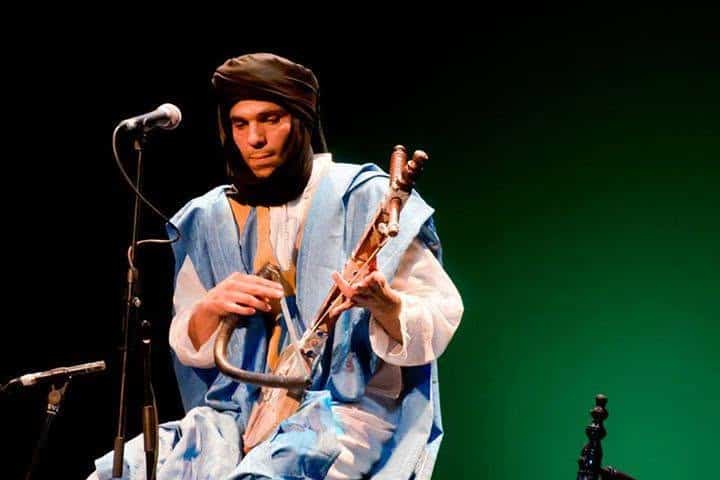
Amazigh musician Larbi Mejjaoui is again being presented as one of the artists carrying the sounds of Souss beyond Morocco’s borders, with new attention around his work in the Canary Islands and wider international festival circuits.
Le Monde Amazigh described Mejjaoui as an artist who has helped give the ribab, often called the Amazigh guitar, a wider contemporary visibility. Coming from Dcheira El Jihadia near Agadir, he grew up in a region shaped by the musical traditions of the Souss and the repertoire of the rways, the poet-musicians whose songs have long carried Amazigh memory, satire, spirituality and social commentary.
His recent and expected appearances in the Canary Islands are culturally significant. The islands have their own pre-Hispanic Amazigh heritage through the Indigenous Guanche past, and modern exchanges between Canary artists and North African Amazigh musicians have become a way to reopen Atlantic cultural memory. In that context, a ribab performance is not only entertainment; it is a bridge between communities that share deep historical layers across the ocean.
The 2026 CoolMoon – Cultures of the World Fest, running from June 4 to 28 across several Canary Islands, presents itself as a travelling festival built around world music, roots traditions, intimate venues and cultural dialogue. Even where the festival program is broader than Amazigh music, the setting helps explain why Amazigh artists find receptive audiences there: the Canary Islands are looking outward toward Africa, the Atlantic and their own layered identities.
Earlier Spanish coverage of Mejjaoui’s concerts in the islands emphasized his use of instruments such as the rebab, guembri, lotar and banjo, and described him as an ambassador of Amazigh culture. His repertoire, performed in Tamazight, brings the language into spaces where many listeners may know Amazigh history only indirectly through archaeology, place memory or family stories.
That is what makes cross-border cultural work powerful. It does not wait for institutions to settle every historical question. It allows audiences to hear continuity through rhythm, voice and instruments. For the Amazigh diaspora, and for Canary audiences interested in their own Indigenous past, these concerts can become moments of recognition.
Mejjaoui’s trajectory also reflects a wider movement among Amazigh artists: taking local forms seriously enough to let them travel. Rather than treating the ribab as a museum object, he places it in conversation with world music, contemporary stages and multilingual audiences. That approach gives Amazigh heritage a living future, one performance at a time.
Sources
- Le Monde Amazigh: Larbi Mejjaoui, une voix amazighe au-dela des frontieres
- Takeo Global: 10th CoolMoon – Cultures of the World Fest 2026
- El Pais Canario: Larbi Mejjaoui, artista amazigh en Canarias
- EquipoPara: Larbi Mejjaoui, concierto Amazigh