
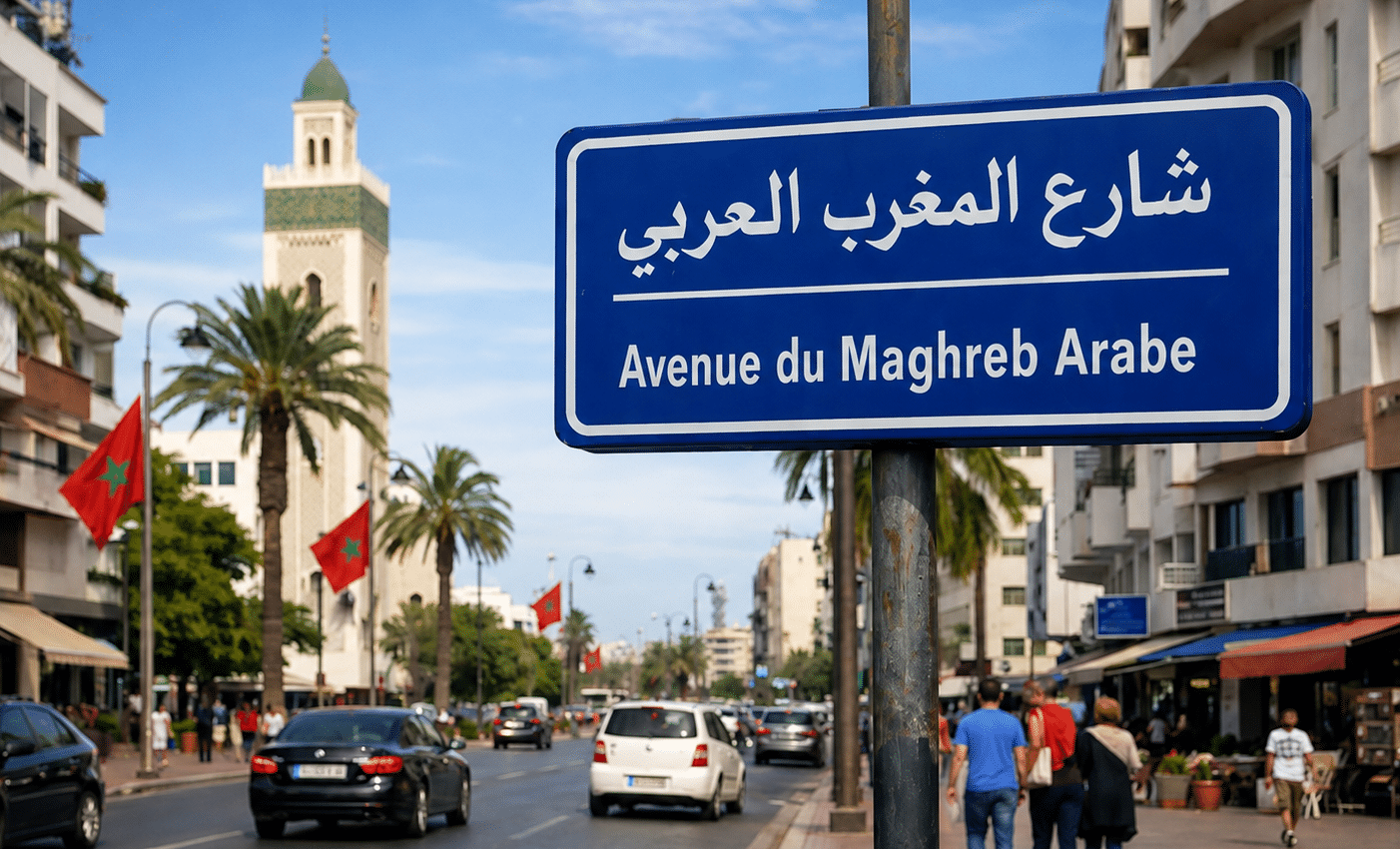
The Amazigh World Assembly AWA is intensifying its campaign to make Morocco’s official recognition of Tamazight visible in the capital itself, calling on Rabat’s mayor to expand the use of Tifinagh on public signage and to review street names that still use the phrase “Arab Maghreb.”
The appeal, reported by Le Monde Amazigh, asks Rabat’s municipal leadership to include Tamazight, written in its Tifinagh script, on street signs, neighborhood names, public squares, municipal facilities and other parts of the city’s public space. The demand is framed not as a symbolic request, but as an implementation issue under Morocco’s 2011 Constitution and Organic Law 16-26, which lays out stages for integrating Tamazight into education and priority areas of public life.
For Amazigh activists, the capital carries particular weight. Rabat is where national policy is announced, contested and administered. If Tamazight remains absent from the streets and institutions of the capital, they argue, constitutional recognition risks being reduced to ceremony rather than lived citizenship.
The Assembly’s request also revives a long-running dispute over terminology. The organization wants references to “Arab Maghreb” in Rabat’s public space replaced by “Grand Maghreb,” a term it considers more consistent with Morocco’s plural national identity. The same issue was raised in May during meetings between an Assembly delegation and parliamentary members from the Socialist Union of Popular Forces and the Authenticity and Modernity Party. In those discussions, the group also criticized the continued use of “Arab Maghreb” by Morocco’s official news agency and called for terminology aligned with the constitution’s recognition of Morocco’s Amazigh, Arab-Islamic, Saharan-Hassani, African, Andalusian, Hebrew and Mediterranean components.
The Rabat appeal comes amid a broader push over the practical meaning of official status. The Assembly has cited limits in Tamazight education, the professional difficulties faced by Tamazight teachers, the need to teach Moroccan diaspora children the language, and the weak presence of Amazigh language and culture in public broadcasting. It has also called for the long-awaited National Council for Moroccan Languages and Cultures to become operational.
There are signs of institutional movement. Le Monde Amazigh recently noted that the new headquarters of Morocco’s national security and territorial surveillance directorates displayed Tamazight in Tifinagh on its official facade, and that Tamazight appeared in some public communication connected to Rabat-Sale tramway advertising for security open days. Such steps matter because they normalize the language in formal settings that citizens encounter directly.
But activists say scattered examples are not enough. Their argument is that official status must be experienced at the level of the city: on signs, at counters, in documents, in public transport, in schools and in media. Rabat is now one of the places where that test is most visible.
The issue is larger than one boulevard name. It asks whether Morocco’s Amazigh identity will be treated as a living part of public administration, or as an identity acknowledged in law while still missing from many daily spaces where the state speaks to its citizens.