
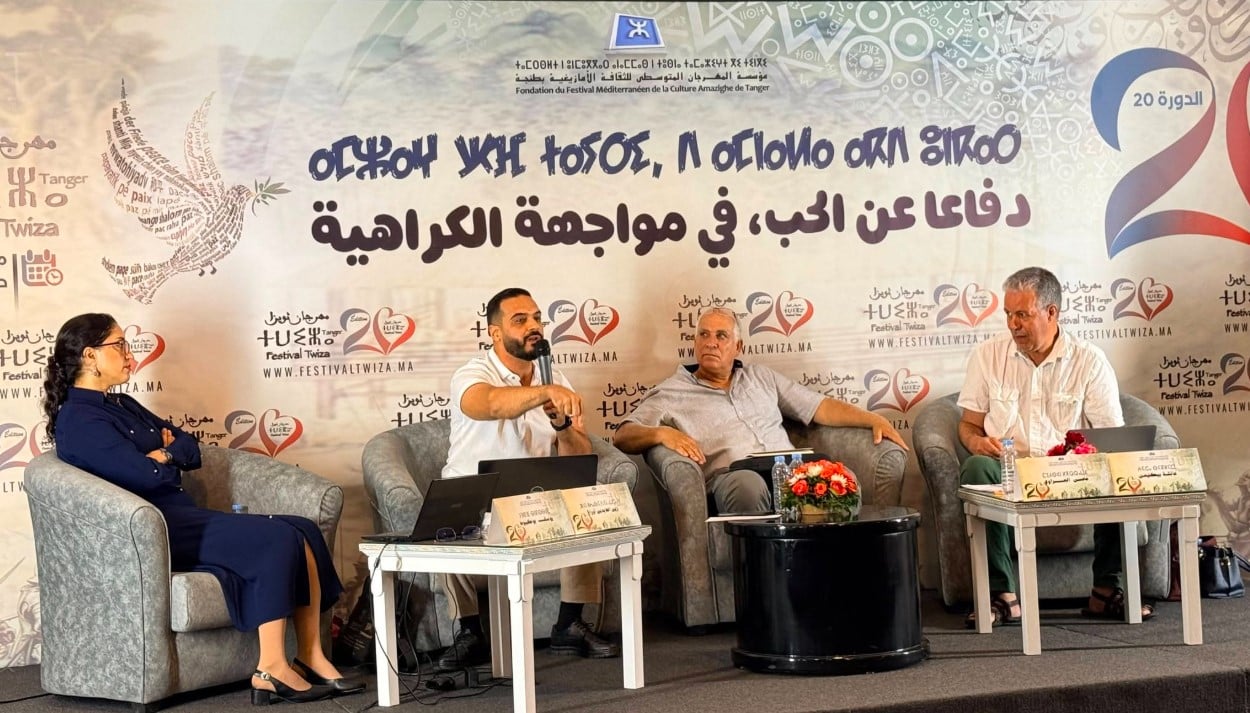
A discussion at Tangier’s Twiza cultural festival has renewed debate over one of the most persistent origin narratives attached to North Africa’s Imazighen: the claim that major Amazigh groups came from Yemen.
Researcher Zine El Abidine Ourragh, speaking during a panel on Morocco and new archaeological discoveries, argued that genetic evidence makes the forced link between Moroccan Amazigh communities and Yemen scientifically untenable. He pointed to comparisons involving medieval remains associated with Yemen and North African samples, saying the results support a strong local North African continuity rather than a Yemeni origin story.
The discussion also referenced Amazigh-linked paternal lineages such as E-M81, which is widely associated with northwestern Africa, while noting that no population history is genetically pure or isolated from migration. The point made by the panel was not that North Africa lacked movement or mixture, but that the older narrative of broad Yemeni descent does not match the evidence now being discussed by researchers.
Archaeologist Youssef Bokbot, from Morocco’s National Institute of Archaeology and Heritage, also warned that many claims of very ancient genealogical descent remain historically difficult to prove. He emphasized the role that archaeology and genetic research can play in separating evidence from inherited stories, especially in a region where identity debates remain politically and culturally sensitive.
For Amazigh readers, the story matters because origin narratives have often been used to frame the Amazigh presence as secondary or externally derived. A research-based account of local continuity strengthens a different reading: that Amazigh identity is rooted deeply in North African history while still acknowledging the region’s long record of contact with the Mediterranean, the Sahara and the wider world.
The panel also underlined the need for careful public communication. Genetic findings can be politically misused if presented as rigid identity labels. The more responsible takeaway is that current evidence challenges simplistic origin myths and supports a more grounded, local and plural history of North Africa.