
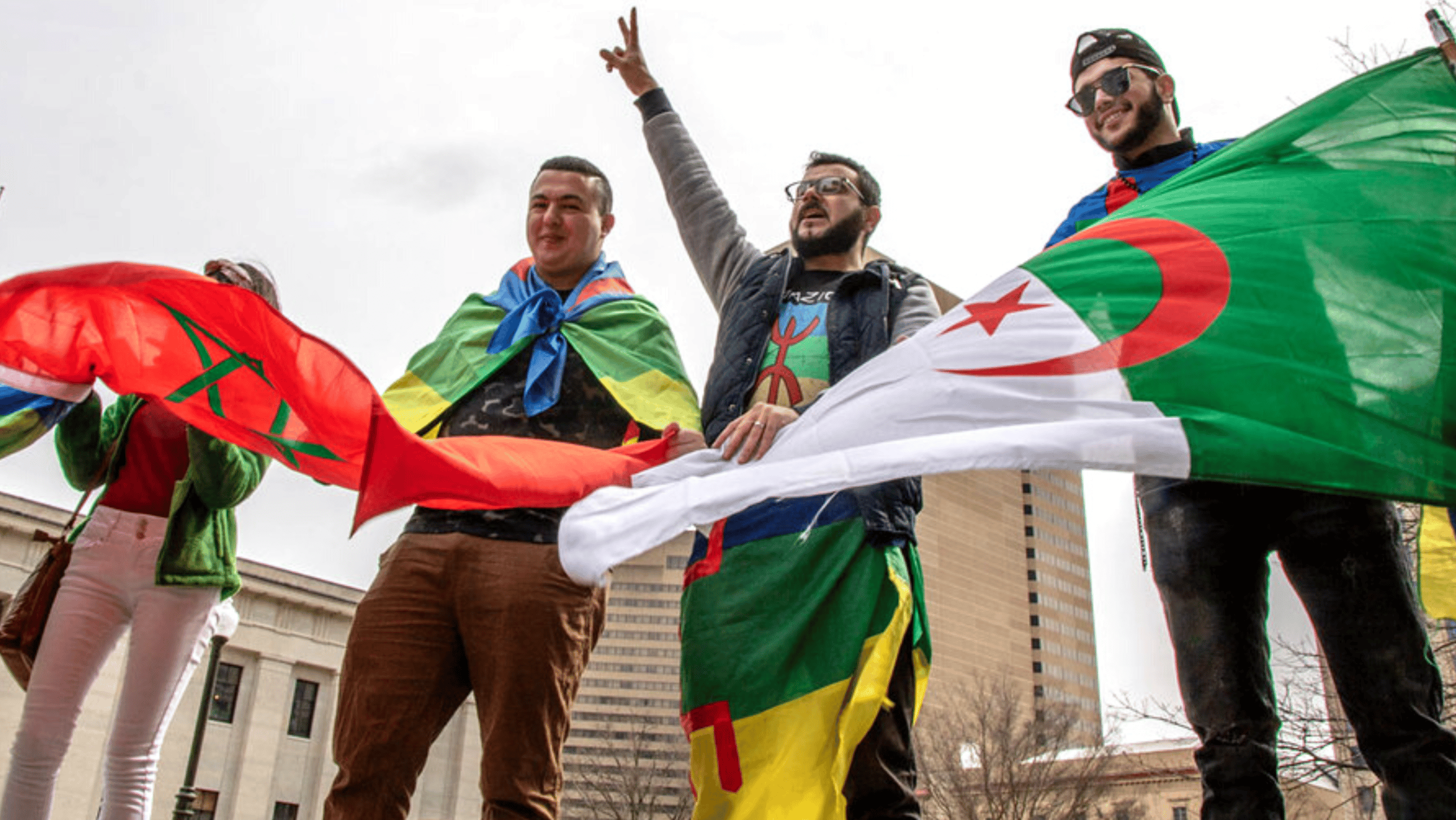
A new report on Algeria’s post-Hirak political climate has again placed Amazigh symbols and Kabylie’s history of protest at the center of the country’s struggle over public freedoms.
In a June 8 article, Le Monde traces the legacy of the Hirak movement, the mass pro-democracy mobilization that began in 2019 and was suspended during the Covid-19 pandemic. The report describes a public sphere where activists, journalists and civil society groups continue to face heavy legal pressure, surveillance and restrictions on expression.
For Amazigh observers, one of the most telling details is the article’s reminder that Algerian authorities arrested protesters in June 2019 for displaying Amazigh symbols. At the time, those arrests were widely seen as an attempt to divide a movement that had brought together citizens from different regions and backgrounds. Instead of isolating Amazigh identity from the broader demand for democratic change, the arrests helped show how closely cultural rights and political freedoms are connected.
The report also situates Hirak within a longer history of Kabylie protest. Le Monde recalls that demonstrations had been banned in Algiers after the 2001 Black Spring, when Kabyle protesters marched against repression and 126 people were killed, many by live ammunition. That memory remains central to Kabylie’s political consciousness and to the wider Amazigh rights movement in Algeria.
According to Le Monde, the post-Hirak period has brought sharper controls on digital speech and associations. The article points to penal-code reforms, prosecutions over social media posts, the dissolution of independent organizations and the expanded use of national-security language against critics. It also notes that Algeria’s terrorism framework has been broadened in ways that can expose people to prosecution for suspected sympathy with banned organizations, including the Movement for the Self-Determination of Kabylie.
This climate has consequences far beyond formal politics. When a flag, a language or a regional identity is treated as a security issue, cultural expression itself becomes vulnerable. For Amazigh activists, the question is not only whether citizens can protest. It is whether Amazigh identity can be visible in public life without being recast as a threat.
The Hirak movement has faded from the streets, but its unresolved questions remain. In Algeria, Amazigh symbols continue to reveal the fault line between state control and the right of citizens to express who they are.