
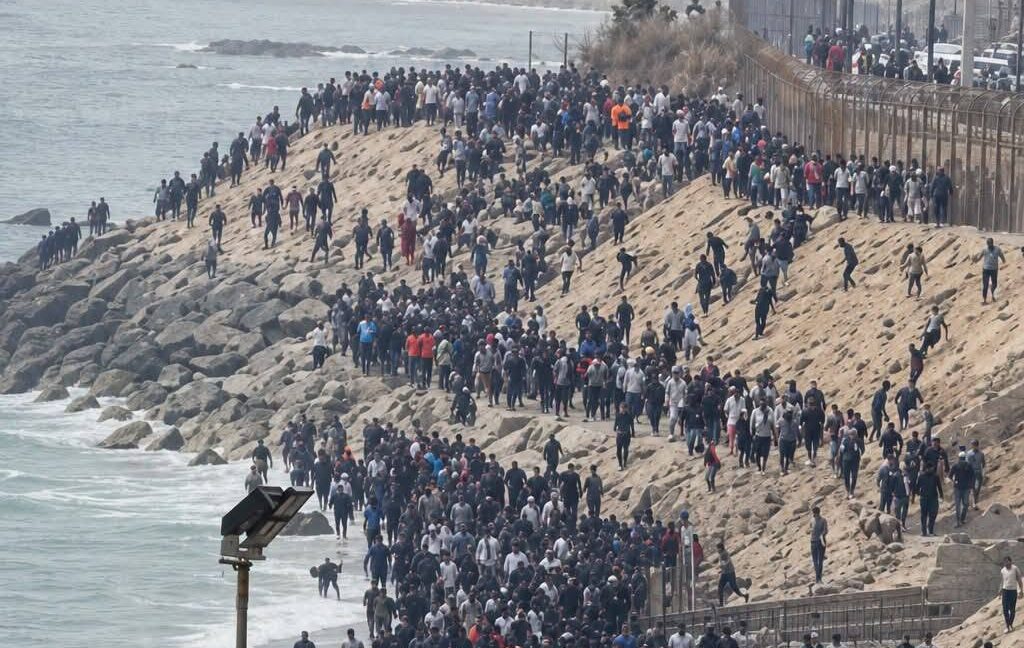
Thousands of people have crossed from northern Morocco into the Spanish-controlled city of Ceuta during a rapidly escalating border crisis, with arrivals taking place both by swimming around the Tarajal breakwater and through the frontier area itself.
The surge intensified on Wednesday and Thursday after several days of repeated swimming attempts from beaches near Fnideq. Spanish security officials said precise numbers were difficult to establish as large groups continued to arrive, while reception and processing facilities in Ceuta came under severe pressure.
Crossings shift from the sea to the frontier
Earlier in the week, most attempts took place at sea. Groups approached the southern Tarajal breakwater, often swimming in poor visibility and difficult conditions. On July 28, more than 70 people reportedly reached Ceuta during one night, while Moroccan forces stopped more than 200 additional attempts.
The situation changed sharply on Thursday when large numbers moved through the Tarajal frontier area. Associated Press reporting described the border as having opened under unusual circumstances, allowing crowds to cross on foot. Spanish police and Civil Guard personnel struggled to process the arrivals as people moved away from the border facilities and into the city.
Ceuta’s regional president, Juan Vivas, characterized the situation as a migration crisis and called for a coordinated national response. Spain’s interior minister, Fernando Grande-Marlaska, was expected to travel to Ceuta to assess the response and meet local authorities.
Reception system faces mounting pressure
Local officials said more than 1,700 people had reached Ceuta by sea during the preceding week. The rapid increase has placed additional strain on accommodation, identification, humanitarian assistance, and child-protection services in a city with limited reception capacity.
The composition of the arriving groups is mixed and includes Moroccans, Algerians, and people from sub-Saharan African countries. Some crossed in family groups, while others were young adults or minors. The use of swimming routes creates acute risks from exhaustion, currents, poor visibility, and collisions near the breakwaters.
Spanish Interior Ministry data already showed a steep rise before the latest escalation. Between January 1 and July 15, nearly 3,000 people had entered Ceuta irregularly by land or sea. Earlier figures for the first half of 2026 showed that arrivals by land routes, a category that includes swimming around the border structures, had increased sharply compared with the same period in 2025.
Morocco and Spain discuss accelerated returns
Spanish and Moroccan authorities said they had agreed to accelerate procedures for returning people who entered Ceuta without authorization. Moroccan diplomatic sources attributed the mass movement to criminal organizations and emphasized the continuing migration cooperation between Rabat and Madrid.
Moroccan forces had conducted operations in northern forests during the preceding weekend to locate groups believed to be preparing to approach the border. Helicopter patrols and ground operations reportedly moved hundreds of people away from areas between Tangier, Tetouan, Fnideq, and the Ceuta perimeter. Those interventions did not prevent the later surge.
The unfolding situation has revived memories of May 2021, when more than 8,000 people entered Ceuta over two days during a period of acute diplomatic tension between Morocco and Spain. The scale and political circumstances of the current episode remain under assessment, and no verified evidence has established a direct political cause for the sudden change at the frontier.
A border with humanitarian and diplomatic consequences
Ceuta and Melilla are the European Union’s only land frontiers on the African continent. Morocco regards both cities as occupied territory, while Spain maintains that they are integral parts of the Spanish state. Their borders are therefore shaped simultaneously by migration control, local commerce, bilateral relations, and competing sovereignty claims.
The immediate priorities are accounting for those who crossed, providing emergency assistance, identifying minors and other vulnerable people, and preventing deaths at sea. Authorities on both sides also face questions about how the Tarajal crossing changed so quickly from a tightly controlled frontier into a route used by large crowds.
The situation remained fluid on Thursday, with official totals and return arrangements still developing.