
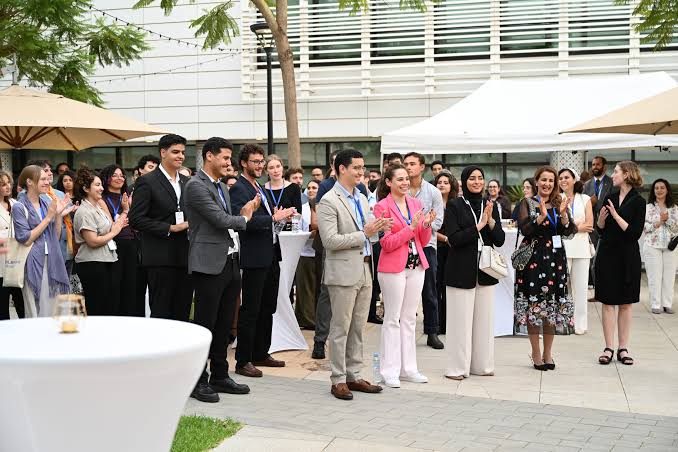
A new cohort of American Fulbright grantees has begun work in Morocco, with several projects placing Amazigh heritage, community knowledge, and cultural preservation at the center of the 2026-2027 academic year.
Morocco World News reports that 24 American Fulbright grantees arrived for research, teaching, and academic exchange after an orientation in Rabat. The group was welcomed by the Moroccan-American Commission for Educational and Cultural Exchange and the US Embassy, as Morocco and the United States mark 250 years of bilateral friendship and the Fulbright Program marks its 80th anniversary.
Several projects are directly relevant to Amazigh communities. One researcher will study Amazigh representation in Moroccan cinema through fieldwork in Ouarzazate, a city closely tied to the country’s film industry. Another project will examine sustainable tourism and preservation of kasbahs and ksour in Souss-Massa and Draa-Tafilalet, regions where architecture, landscape, and Amazigh heritage are deeply connected.
Near Taliouine, a Fulbright researcher will focus on the knowledge traditions of Amazigh women working in a saffron cooperative. That project is significant because it recognizes local women’s expertise as a form of knowledge in its own right, rather than treating rural production only as an economic activity.
The cohort also includes a project with High Atlas communities affected by the 2023 earthquake, exploring participatory artificial intelligence tools that could help reconstruct and preserve cultural heritage. If handled carefully and collaboratively, such work could contribute to community-led documentation at a time when many villages are still negotiating the material and cultural consequences of disaster.
The Fulbright program’s Moroccan slate shows how Amazigh heritage is increasingly appearing in interdisciplinary research: cinema, tourism, architecture, women’s cooperative knowledge, manuscripts, AI, and education all intersect. The challenge will be ensuring that communities are treated as partners in knowledge production, not merely as research sites.
Nearly 50 Moroccan Fulbright recipients are also traveling to the United States this academic year, making the exchange two-way. For Amazigh-related research, that reciprocity matters: it opens space for Moroccan scholars, teachers, and cultural workers to shape how heritage and contemporary social questions are studied across borders.