
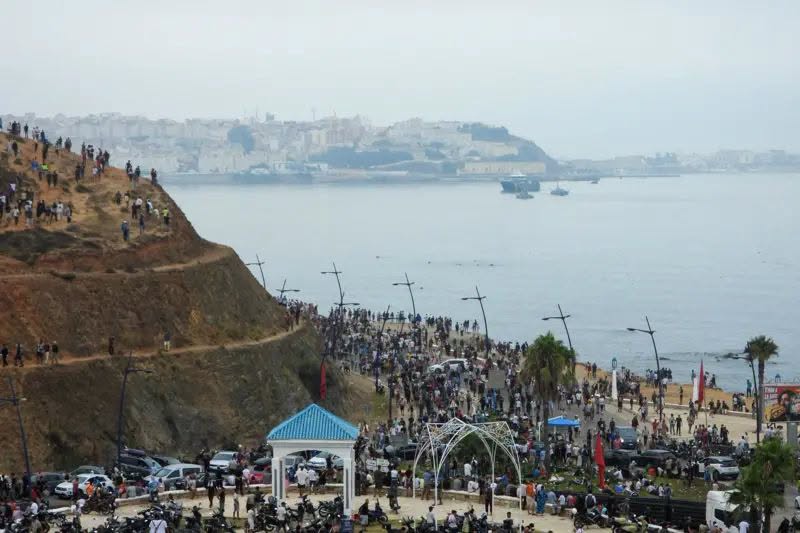
Melilla closed its border with Morocco as the unprecedented crossing crisis in Ceuta spread eastward along the North African coast. Spanish authorities said 130 people entered Melilla after the closure, including 84 minors, while reinforced Moroccan security operations prevented larger groups from reaching the perimeter.
The developments show that the emergency is affecting both Spanish-controlled cities, although the scale and response have differed sharply. Ceuta received tens of thousands of people after controls at Tarajal broke down. Around Melilla, the Beni Enzar frontier remained closed and Moroccan forces maintained a stronger presence on approaches from the Nador region.
Authorities report 130 entries, most involving minors
Melilla’s central-government delegate, Sabrina Moh, said 130 people crossed after the border was shut. Eighty-four were minors, creating an immediate need for identification, shelter, medical screening, and child-protection services.
The presence of so many minors distinguishes the Melilla episode from a routine border interception. Spanish authorities must determine whether children arrived alone or with relatives, assess their welfare, and place unaccompanied minors under the appropriate protection system.
Officials described the border closure as a preventive measure intended to stop the much larger movement seen in Ceuta from being repeated in Melilla. According to a Rif.fm report compiled from EFE, Europa Press, and official statements, 357 Civil Guard and National Police officers took part in the overnight operation, supported by Local Police and emergency services. Specialized units included the Civil Guard’s Underwater Activities Specialist Group and Rapid Intervention Units.
Crossings reported at several points; dozens treated
The attempts were not limited to the main Beni Enzar crossing. People also reached the Dique Sur breakwater and the former Barrio Chino and Farhana crossing points. Rif.fm reported that roughly 60 people received medical attention, mainly for fractures and open wounds, and three were taken to hospital. Three officers—two National Police members and one Civil Guard member—were also injured.
The Government Delegation said Beni Enzar would reopen only after the perimeter was fully cleared and security conditions allowed it. No reopening time had been announced.
Moroccan forces tighten control near Nador
On the Moroccan side, security deployments were reported around routes leading from Nador toward the frontier. El País reported that Morocco’s response near Melilla differed from the initial breakdown of controls at Ceuta, with authorities moving to contain groups before they could reach the fence.
The Nador branch of the Moroccan Association for Human Rights raised concerns about force used during dispersal operations and the treatment of people in vulnerable conditions. Such claims require independent scrutiny, particularly when children and people exhausted by long journeys are involved.
Melilla’s frontier has long combined intensive policing with daily economic and family ties across the border. A sudden closure disrupts not only migration routes but also residents and workers whose lives connect Nador, Beni Enzar, and Melilla.
Pressure was rising before the current emergency
Official figures had already shown increased arrivals in 2026. During the first half of the year, 116 people entered Melilla irregularly, 43.2 percent more than in the same period of 2025. The 130 entries reported during the current closure therefore exceeded the entire first-half total in a short period.
Human-rights monitors have also documented continuing dangers in the region. Caminando Fronteras reported 28 deaths on the Alboran route during the first five months of 2026, a category that includes people attempting to swim toward Melilla. The organization’s figures underline the risks of both maritime and land approaches.
Ceuta and Melilla face a shared regional crisis
The immediate pressure in Melilla remains far below the approximately 50,000 crossings estimated in Ceuta. Nevertheless, the movement of attempts from one frontier to the other suggests that authorities cannot treat the two cities in isolation.
Morocco considers Melilla and Ceuta occupied territories; Spain says both are integral parts of the Spanish state. This unresolved sovereignty dispute sits alongside close cooperation on migration, trade, and security. During moments of crisis, decisions taken at one border quickly affect the other and the surrounding Amazigh regions of the Rif.
For Melilla, the priorities are safeguarding minors, preventing deaths, keeping accurate public records, and ensuring that security operations comply with human-rights standards. The border’s reopening and any new return arrangements had not been clearly established as of Friday.