
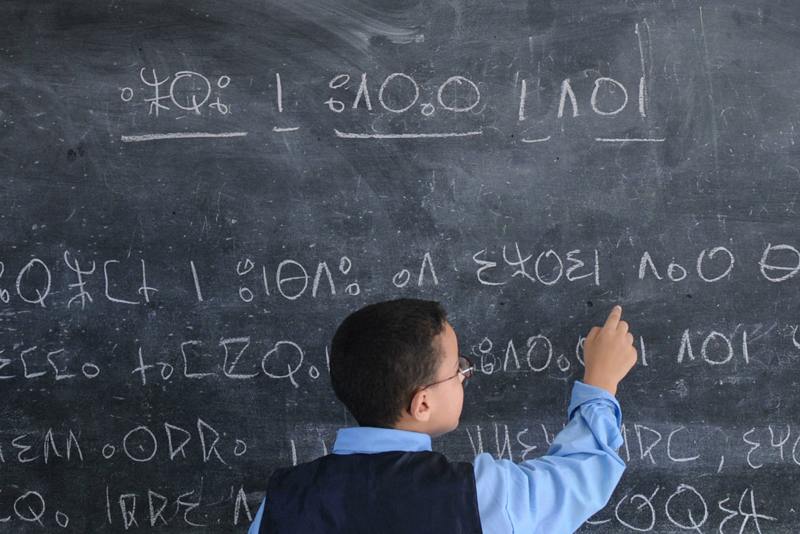
Moroccan youth, especially students who entered school after tamazight language was introduced into public education, appear more open to learning the language and using the Tifinagh script than their parents, according to a new academic study cited by Rif FM.
The study, published in the European Journal of Language Policy and authored by Kawtar Sabri and Daouia El Aboudi, examined how students and parents respond to Morocco’s policy of integrating Amazigh into schooling. The research combined quantitative and qualitative methods, including a survey of 152 students across primary, middle, and secondary levels in El Jadida province, along with in-depth interviews with 15 parents.
The findings show notably positive attitudes among students. Around 90 percent described their experience of learning Amazigh in primary school as positive, while more than 63 percent said they wanted to continue studying it in later school years. Most did not see the subject as an added burden and opposed removing it from the curriculum.
On Tifinagh, more than half of the students said they were comfortable reading and writing in the script, even if some still considered it relatively difficult. The researchers argue that this technical difficulty does not amount to rejection of either the script itself or the educational policy built around it.
The study also found that enthusiasm for learning Amazigh is strongest in primary school, where it exceeds 94 percent, but drops by roughly half at the secondary level. The authors suggest that this reflects the growing academic pressure students face as they advance through school.
Statistical analysis showed a clear link between students’ attitudes toward Amazigh and both age and school level, but no link with the number of years they had studied the language. The researchers say this suggests that attitudes are shaped not just by classroom exposure, but also by maturity and a growing awareness of national identity and linguistic diversity.
Parents, by contrast, expressed a more cautious and pragmatic position. Most acknowledged that Amazigh is an essential part of Moroccan identity and deserves protection, but that symbolic recognition does not always translate into support for making it a compulsory subject. Some parents said they saw Amazigh as carrying more cultural value than educational or professional utility when compared with Arabic or French, while others worried it could create extra academic pressure, especially in non-Amazigh-speaking areas.
Even so, the study did not record outright hostility to teaching Amazigh. Instead, it describes many parents as occupying a position of what it calls pragmatic neutrality: they do not oppose the state’s policy, but remain somewhat distant from the language in practical terms.
On Tifinagh, interviewed parents generally accepted the script as the authentic writing system of Amazigh and rejected replacing it with Arabic or Latin letters. The study says that support seems to stem mainly from a symbolic attachment to Amazigh identity rather than from detailed knowledge of language-revival policy or script debates.
The researchers conclude that the gap between the two generations reflects a gradual social shift. Students who grew up after Amazigh entered the school system appear less shaped by older negative stereotypes, while many parents still carry the legacy of a period when Amazigh was marginalized in official and educational settings.
They argue that the long-term success of Amazigh integration depends not only on teachers and curricula, but also on changing wider social perceptions, especially among parents. The study calls for stronger communication around the goals of Morocco’s language policy and for continued implementation of the constitutional recognition of Amazigh as an official language.