
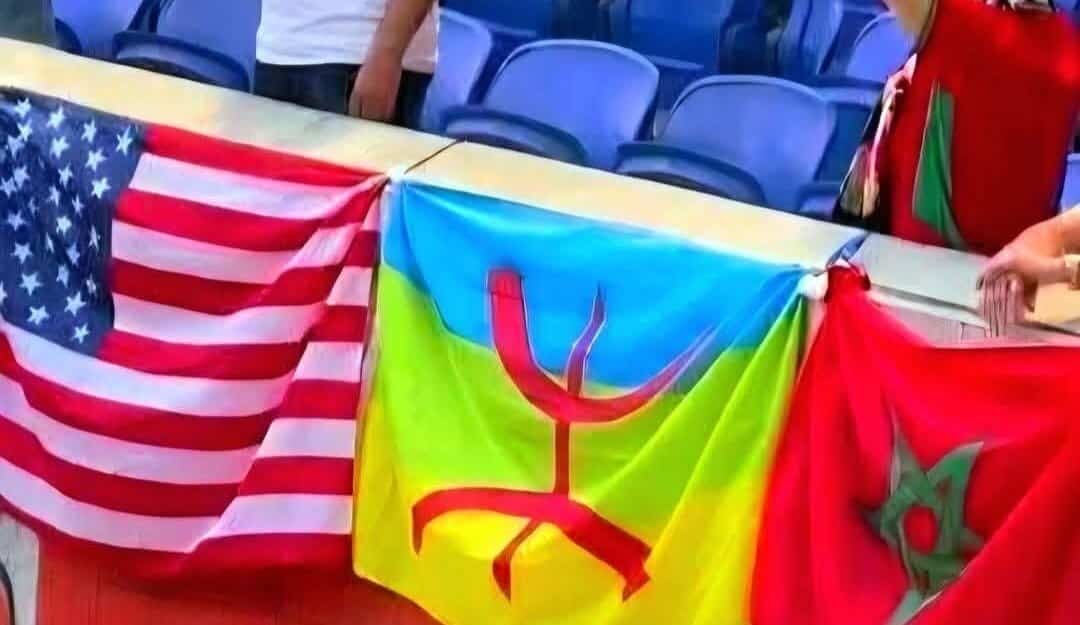
Morocco’s 1-1 draw with Brazil in its 2026 World Cup opener was not only a tactical result against one of football’s historic powers. For many Moroccans and Amazigh communities watching from North Africa, Europe and North America, it was another reminder that the Atlas Lions now carry a public identity larger than the pitch.
The Group C match in East Rutherford, New Jersey, put Morocco back under the global spotlight four years after its historic 2022 semifinal run. According to The Guardian match report, Morocco struck first through Ismael Saibari in the 21st minute after a fast break, before Vinicius Junior equalized for Brazil in the 32nd minute. The same report described Morocco as composed, tactically sound and deserving of the draw.
That performance matters because Morocco’s football image has become one of the most visible places where the country’s layered identity is discussed internationally. The Atlas Lions are often framed as Arab, African, Muslim and diaspora at once. But for Amazigh audiences, Morocco’s World Cup rise also opens space to insist on another truth: the country’s national story is rooted in Indigenous North African culture too.
A recent New Yorker profile of Morocco’s World Cup team recalled that Moroccan players and supporters displayed Amazigh symbols during the celebrations around the 2022 run. Those symbols were not decoration. They were a public reminder that Moroccan identity cannot be reduced to a single language, region or political label.
Against Brazil, the strongest symbol of Morocco’s future may have been youth. The Guardian highlighted 18-year-old midfielder Ayyoub Bouaddi as one of the match’s standout players, noting his control, composure and ability to compete against Brazil’s experienced midfield. The article reported that Bouaddi completed 93 percent of his passes, had 88 touches and won 11 duels in a performance that drew attention far beyond Morocco.
Bouaddi’s story also reflects the modern Moroccan football model. Born and developed in Europe, he represents a generation shaped by diaspora pathways, elite academies and international choice. Morocco’s ability to bring such players into the national project has made the team more competitive, but it has also turned the Atlas Lions into a meeting point for Moroccans who live across borders.
For Amazigh World News readers, this is the deeper story behind the result. Morocco did not simply hold Brazil. It showed again that North African football can carry identity, memory and cultural argument into a global arena. When the Atlas Lions play, millions are not only watching tactics and score lines. They are watching how Morocco represents itself to the world.
The next challenge is to make sure Amazigh identity remains visible inside that representation. The World Cup gives Morocco an enormous stage. The question is whether the story told on that stage will be honest enough to include all of Morocco: Arab, African, Amazigh, Saharan, Muslim, Jewish, diaspora and local.
After the Brazil draw, one thing is clear. The Atlas Lions’ World Cup journey is still a place where football and identity meet, and Amazigh pride belongs in that conversation.
Sources
- The Guardian: Vinicius Junior rescues lacklustre Brazil as Morocco earn deserved World Cup draw
- The Guardian: Brilliant teenager Bouaddi glides on to big stage with effortless grace for Morocco
- The New Yorker: How the Moroccan World Cup Team Became a Symbol of the Global South