
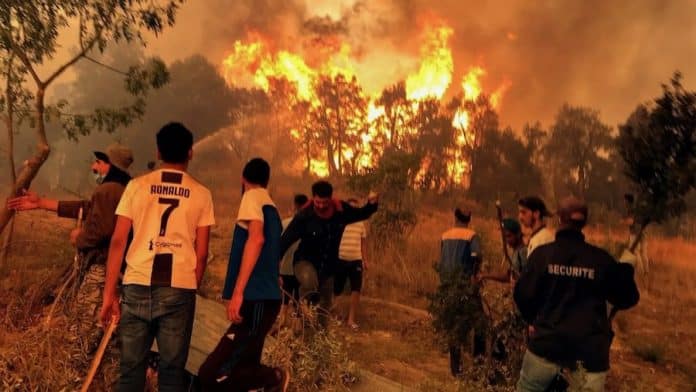
Several parts of Kabylie have been battling forest fires after two days of extreme heat, with Tamurt reporting major outbreaks around Bgayet and Ait Ourtilane.
The report, published July 13, said temperatures locally approached 44 to 46 degrees Celsius as fires struck mountain forests, scrubland and ancestral olive groves. In Bgayet, localities including Ait Maouche, Ouzelaguene, Tichy and Ighrem were affected, while new fires were reported as dry winds complicated containment work.
Civil Protection units, forestry services and residents reportedly helped bring several major fire fronts under control, but the situation remained unstable. The geography of Kabylie’s mountain villages makes such fires especially dangerous: homes often stand close to orchards and scrub on steep slopes, allowing flames to move quickly toward inhabited areas.
Tamurt highlighted heavy local losses, including the destruction of a poultry farm in Ait Djelil where 28,000 chicks were reportedly killed. The article also described residents who rushed to help neighbors, including young volunteers whose motorcycles were destroyed while they assisted in the response.
Ait Ourtilane, in the Kabylophone part of Sétif, was also reported to be fighting fires in difficult terrain. The steep relief made access hard for firefighting vehicles, increasing reliance on local solidarity and mobile emergency columns.
The fires underline the vulnerability of Amazigh mountain communities to heat waves, drought and under-resourced emergency response. For residents, the damage is not only environmental: olive groves, poultry farms and village transport are tied directly to family livelihoods and local continuity.