
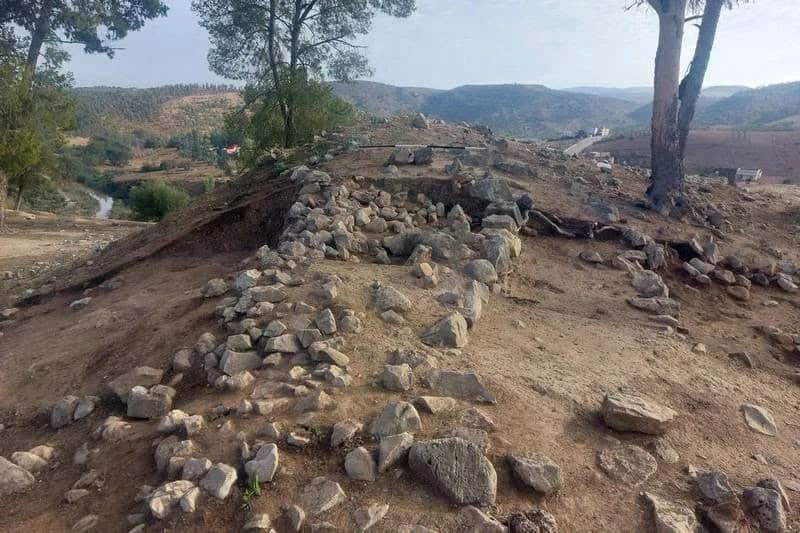
New excavation results from Oued Beht in northwestern Morocco are adding a major chapter to the deep history of North Africa. An international team working at the site has identified a ditch-and-rampart defensive system dated to roughly 3,500 to 4,000 years ago, making it the oldest known large-scale defensive structure in North Africa outside the Nile Valley.
The finding comes from the Oued Beht Archaeological Project, whose third field season focused on the chronology, layout and later reuse of the site in Khémisset province. The project brings together Moroccan, Italian and British researchers, including Morocco’s National Institute of Archaeological and Heritage Sciences, Italy’s National Research Council, the University of Cambridge and ISMEO.
Oued Beht had already drawn scholarly attention as one of the most important prehistoric settlement sites in the western Mediterranean. Earlier work identified a large settlement on a ridge overlooking the Oued Beht river, with evidence of farming, livestock and connections across the Strait of Gibraltar. The new publication in Libyan Studies extends the story by showing that the site continued to matter during the second millennium BCE.
The defensive structure appears to have blocked access to the southern end of the settlement, using the ridge’s natural topography to make the area easier to protect. Researchers say the scale of the earthwork points to planning, organized labor and a community capable of reshaping settlement space for strategic purposes.
For Amazigh and North African history readers, the discovery matters because it challenges older narratives that treated prehistoric Morocco as peripheral to Mediterranean developments. The evidence suggests that communities in the northwestern Maghreb were not isolated, but were building, farming, exchanging and adapting in ways that deserve comparison with societies across the western Mediterranean.
The project also documented later reoccupation, including a medieval stone wall and cemetery above the older earthwork. That long sequence makes Oued Beht valuable not only for the Bronze Age, but also for studying how communities returned to meaningful places over thousands of years.