
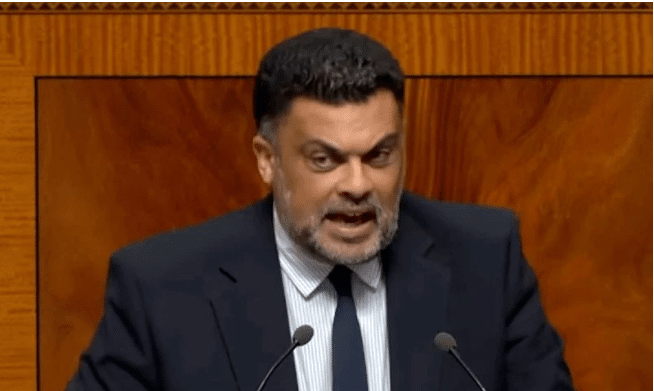
RABAT, Morocco — A dispute over Morocco’s official languages has intensified after an Amazigh advocacy organization demanded a public apology from parliamentarian Omar Mahmoud Benjelloun, accusing him of making exclusionary remarks about the Amazigh language during a parliamentary debate.
Agraw for Amazigh, an organization affiliated with the Authenticity and Modernity Party (PAM), criticized the lawmaker from the Federation of the Democratic Left following his intervention in the House of Representatives on October 22, 2026.
In a statement dated October 22 and reported by Moroccan media on October 23, the organization said Benjelloun referred to government funding for implementing the official status of Tamazight before describing Arabic as Morocco’s official language in terms that, according to Agraw, disregarded the country’s constitutional linguistic diversity.
Remarks Spark Criticism
The controversy centers on Benjelloun’s reported reference to Arabic as Morocco’s official language, using the expression “the language of Dad,” a traditional designation for Arabic.
Agraw argued that the statement effectively reduced Morocco’s official linguistic identity to Arabic, despite the constitutional recognition of Tamazight as an official language alongside Arabic since 2011.
The organization described the intervention as exclusionary and discriminatory, calling on Benjelloun to publicly clarify his position on Amazigh linguistic rights and the financial resources allocated to their implementation.
However, a separate account published by Le61.ma presented additional context. According to that report, Benjelloun acknowledged Tamazight’s official status and the allocation of MAD 2 billion toward its promotion, while arguing that government policy should also strengthen Arabic.
This distinction is important because the available reports do not establish that Benjelloun explicitly called for eliminating Tamazight funding or reversing its constitutional recognition.
Organization Calls for Parliamentary Accountability
Agraw’s demands go beyond an apology.
In its statement, signed by national coordinator Rachid Bouhaddouz, the organization called on Benjelloun’s political party and parliamentary group to assume political responsibility for the remarks delivered in their name.
It also urged the leadership of the House of Representatives to protect linguistic and cultural diversity during parliamentary proceedings and consider disciplinary measures where appropriate under parliamentary rules.
The organization further called for legislation addressing discrimination against Amazigh speakers and identity-based hostility, including discriminatory insults, incitement to hatred and denial of rights. Its proposal also emphasized safeguards for freedom of expression, criticism and academic research.
Agraw additionally criticized what it described as mockery of the government leader’s pronunciation, influenced by the Marrakesh variety of Moroccan Darija, arguing that regional accents should not become grounds for ridicule or discrimination.
MAD 2 Billion Announcement Raises Questions About Implementation
The controversy comes days after Prime Minister Fatima-Zahra El Mansouri announced, on October 19, a special fund of MAD 2 billion to support the implementation of Tamazight’s official status.
The announcement included plans for ministerial oversight and annual reporting on the language’s integration into education, public administration, justice, media and public signage.
However, subsequent reporting revealed an important distinction between the announced commitment and the proposed annual budget.
According to an October 24 investigation by Le Desk, the draft 2027 Finance Bill establishes a dedicated Amazigh officialization fund under the authority of the head of government, with MAD 400 million allocated for 2027.
The report noted that the government had not clarified whether the larger MAD 2 billion announcement represented a multiyear commitment. It also found that a detailed public accounting of earlier Amazigh-related spending remained unavailable.
The debate therefore raises two separate questions: whether Tamazight receives recognition consistent with its constitutional status, and whether public funds dedicated to that recognition produce measurable improvements.
Constitutional Recognition and Continuing Challenges
Morocco’s 2011 Constitution recognizes both Arabic and Amazigh as official languages. Article 5 specifically identifies Amazigh as a common heritage belonging to all Moroccans without exception.
Organic Law No. 26-16, enacted in September 2019, established a phased framework for integrating Amazigh into public life, including education, parliamentary proceedings, government services, official documents and the justice system.
The law sets implementation deadlines of five, ten and fifteen years, depending on the sector.
Despite that framework, implementation remains uneven.
An October 20 report by Médias24 highlighted continuing difficulties in education, citing research indicating that Amazigh was taught in only 31% of primary schools in 2024.
Meanwhile, government-reported progress has included the deployment of Amazigh-speaking reception personnel, bilingual signage and sectoral integration plans. Le Desk reported that authorities had identified 491 reception agents and 25 sectoral action plans by June 2026.
These figures illustrate why Amazigh advocacy groups continue to demand not only budgetary commitments but also clear implementation schedules and independently assessable results.
Wider Debate Over Linguistic Equality
The parliamentary exchange has also prompted responses from Amazigh intellectuals.
In an opinion article published by Rfm on October 25, researcher Abdelssalam Khalfi challenged the idea that funding for Amazigh should be evaluated without considering the longstanding institutional resources available to Arabic.
Khalfi argued that meaningful equality requires examining access to teachers, administrative personnel, judicial services and public broadcasting, rather than comparing isolated budget allocations.
His article was an opinion intervention, and its numerical comparisons have not been independently verified for this report.
The disagreement illustrates a broader divide over language policy. Some participants in the debate emphasize the need to protect and strengthen Arabic alongside Amazigh, while Amazigh advocates argue that decades of unequal institutional development require targeted measures to make constitutional equality effective.
Calls for Clarification Remain
Agraw has maintained that recognizing Amazigh as an official language must be reflected in parliamentary discourse, government budgets and public services.
Its statement calls for an explicit apology from Benjelloun, a clear position from his parliamentary group and stronger institutional safeguards against linguistic discrimination.
At the same time, the available reporting contains differing interpretations of Benjelloun’s intervention. A complete official transcript or recording of the relevant exchange was not independently verified for this article, and no verified response from Benjelloun to Agraw’s apology demand was identified in the sources reviewed.
As Morocco prepares to examine its 2027 budget, the controversy places renewed attention on a question that extends beyond any individual lawmaker: how the country will translate the constitutional recognition of Tamazight into equal and accessible public services.