
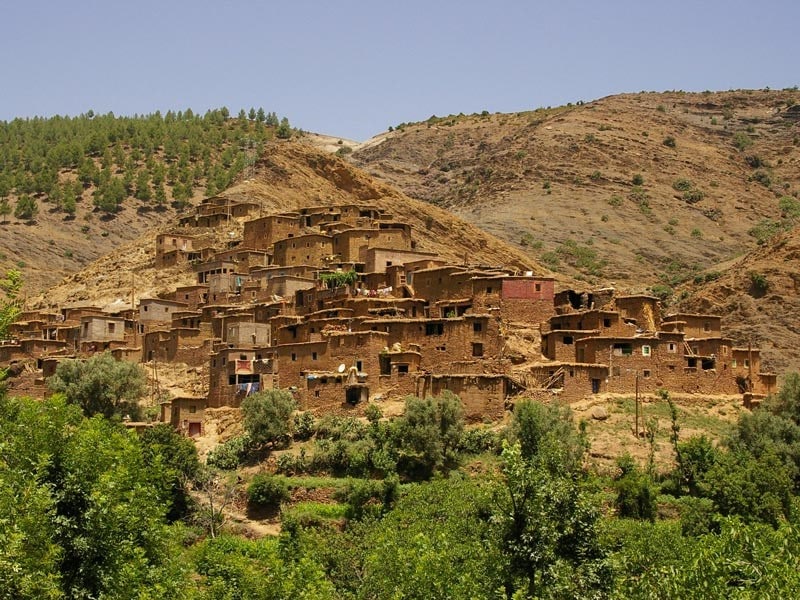
Morocco’s Middle Atlas will host a new effort this November to document and protect one of the region’s most important living Amazigh pastoral systems. The first National Conference on Pastoral Transhumance in Morocco is planned for November 15 and 16 in Oum Errabia, Khénifra province, with the Agdal system at the center of the agenda.
The meeting is organized by the Tifsa Atlas Association for Sustainable Development under its “Agdal for Nomadic Pastoralism” initiative. It is listed within the International Year of Rangelands and Pastoralists framework and is being presented as a first step toward a possible UNESCO intangible heritage candidacy in 2027-2028.
Agdal is more than a pasture. In Amazigh mountain communities, it refers to a collective system for managing access to natural resources. In pastoral areas, communities may temporarily close grazing zones so vegetation can regenerate before reopening them according to local rules. The practice links ecology, customary law, seasonal mobility, oral knowledge and community authority.
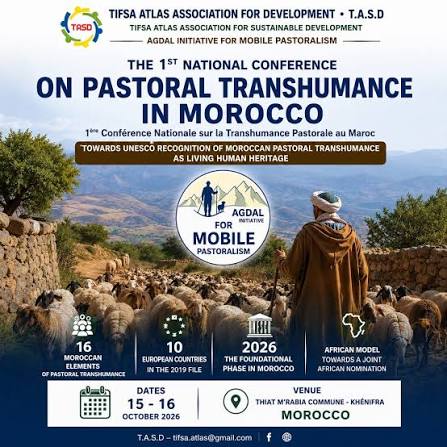
Organizers estimate that 15,000 to 20,000 pastoral households in the Middle Atlas remain tied to these practices. The conference aims to document that knowledge at a national scale, create a scientific and policy network, and develop recommendations for protecting pastoral spaces under climate pressure.
The programme is expected to bring together universities, Khénifra National Park, the Royal Institute of Amazigh Culture, breeders’ associations and international experts. The second day is planned as a public session with discussion of transhumance, administrative boundaries, UNESCO candidacy and cultural expressions such as pastoral music and oral poetry.
The initiative arrives at a time when drought, land pressure and rural economic change are reshaping pastoral life across Morocco. Supporters argue that the Agdal system offers both heritage value and practical knowledge for climate resilience, because it reflects generations of collective adaptation to fragile mountain ecosystems.
A future UNESCO file is still only a possibility, not a completed candidacy. But the Khénifra conference could mark an important shift: treating Amazigh pastoral governance not as folklore, but as a living knowledge system with national and international significance.