
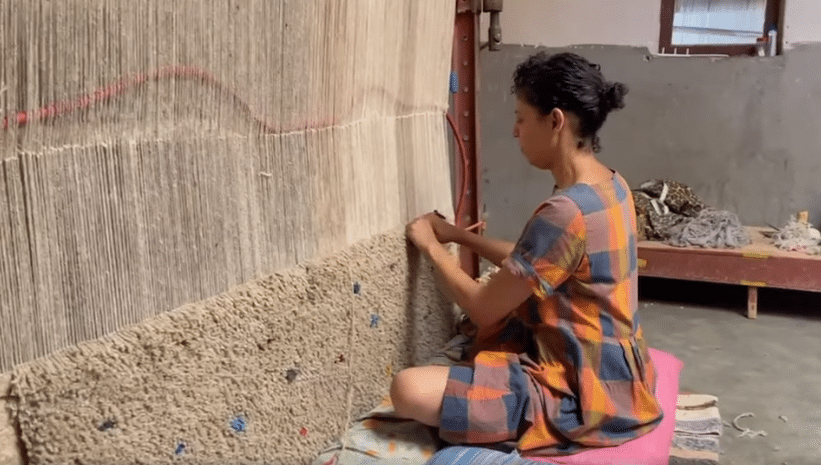
A new exhibition in the Netherlands will place Amazigh textile memory at the center of a Dutch museum program, as designer Mina Abouzahra prepares to open Woven Letters at Museum Gouda on September 26.
The exhibition is the first monographic show dedicated to Abouzahra, a Dutch designer of Moroccan origin whose work moves between Amsterdam and Taznakht in southern Morocco. It brings together furniture and rugs that draw on Moroccan craft traditions while speaking to contemporary questions of migration, family history, and cultural transmission.
The show’s central idea is that a Moroccan rug is not only an object of design. In Amazigh traditions, woven forms can carry symbolic references to femininity, marriage, protection, fertility, mourning, and personal memory. The exhibition title points to that communicative role: textiles can function as letters, even when they do not use written words.
One featured work, Carta, refers to a Taznakht tradition in which a young Amazigh bride separated from her family expresses her emotional state through a rug. The piece turns weaving into a language of distance, absence, and return. In a diaspora context, that theme also speaks to families whose connections to Morocco are maintained through objects, stories, and inherited skills.
The Gouda exhibition will run alongside the museum’s broader autumn program on local textile history. Abouzahra has also worked with Gouda communities on contemporary cushions woven in Taznakht, creating a bridge between Dutch guild traditions and Moroccan Amazigh craft. That connection carries extra resonance in a city where many residents have Moroccan roots, including families linked to the Rif.
Abouzahra’s work has previously received Dutch and European design recognition, but Woven Letters gives her practice a broader museum frame. For Amazigh culture, the exhibition is another example of how women’s weaving traditions continue to travel, adapt, and speak across generations.